
Side-out scoring vs rally scoring in pickleball
Short answer: In traditional side-out scoring only the serving team scores. In rally scoring, which USA Pickleball provisionally recognised in 2025, a point is awarded at the end of every rally to whichever side wins it.
Most recreational games use side-out scoring. USA Pickleball's skills article on rally scoring explains the newer option.
How rally scoring works
A point goes to the server or the receiver after each rally. Games must still be won by two points. A key detail from the 2026 rulebook: the game-winning point can only be scored by the serving side. If a team is at game point and the opponent serves and loses the rally, it is a side out and no point is awarded.
In rally scoring doubles, the approved format lets servers serve to both opponents and from both sides of the court. Each team serves until it loses a rally. There is no second server, so the starting score is 0-0, not 0-0-2.
Positioning follows the score
The starting server serves from the right (even) side when their team's score is even and the left (odd) side when it is odd. When the serving team wins a rally, the server and partner switch sides. USA Pickleball's example: in a 15-point singles game, a player at 14 can serve to win if the opponent has fewer than 14.
Where it is allowed
USA Pickleball's formats guide says tournament directors may choose rally scoring as a provisional option for singles and doubles round robins, team play and singles double elimination, but not for doubles double elimination. The same page notes that for 2025 the Golden Ticket events and USA Pickleball National Championships used side-out scoring. Check the current tournament rules before assuming either system.
Standard (side-out) scoring in the rulebook
Rule 4.A says a point is scored by serving the ball and winning the rally. The winner of the game is the first singles player or doubles team that scores the winning point (4.B). Typically that means 11 points, leading by at least 2. Only the serving side can score. A receiver who wins a rally wins the serve, not a point. The rulebook describes rally scoring as a provisionally approved option, covered in its section 14.
Rally scoring: what USA Pickleball says
USA Pickleball's skills page says that in 2025 it provisionally recognised rally scoring for singles and certain doubles formats. For USA Pickleball sanctioned tournaments, directors may use doubles rally scoring for round-robin and team play, and singles rally scoring for double-elimination play.
Rally-scored singles
- A point is awarded for each rally, either to the server or the receiver.
- Positions follow the same pattern as traditional singles: the server aligns by score, right court for even and left for odd.
- Games must be won by two points and can continue past the scheduled game point.
- No points are awarded when a player is at game point and the opponent loses their serve. The game must be won on serve.
Rally-scored doubles
- A point is awarded to the serving or receiving team at the end of each rally.
- The winning team must win by two points and must win the rally on their own serve.
- Each team serves until it loses a rally. Then the opponents are awarded a point and serve. There is no second server.
- The game starts at 0-0.
- When the serving team wins a rally, the server and partner change positions. When the serving team's score is even, the first server in the game for that team is on the right side when serving or receiving, and on the left when it is odd.
- After a side out, the serve is always initiated from the right court, and the new serving team's players change positions to line up with the score.
- There is no freeze: if the serving team loses a rally while the opponent is on game point, no point is awarded and the game continues.
A worked example from the USA Pickleball page
In a 15-point game, a serving team on 14 points can serve to win if their opponent has fewer than 14. If the teams are tied at 14, the winner of the rally still scores, making it 15-14. If the serving team at 15-14 loses the next rally, the score becomes 15-15 and the opponent serves.
Which is better?
That is a matter of format and taste. Rally scoring makes match length more predictable, because every rally produces a point, which is why it is offered for round-robin and team play. Side-out scoring has more comebacks possible because only the server scores. We have not tested either claim against data, so treat these as general observations. If you are entering a tournament, check which format is in use.
See doubles serving order, singles serving and calling the score.
Frequently asked questions
Which scoring system should I use for casual games?
The sources describe the options available to tournaments. For casual play, agree on the system before the first serve.
Who can score in standard pickleball?
Only the serving team, by winning the rally (rule 4.A).
Is there a second server in rally-scored doubles?
No. Each team serves until it loses a rally, then the opponents are awarded a point and serve.
Is rally scoring official?
USA Pickleball provisionally recognised rally scoring in 2025 and the 2026 rulebook lists it as a provisionally approved option.
Does a game have to end exactly at the target score?
No. In rally scoring as described by USA Pickleball, the winner needs a two-point margin and the game can extend past the scheduled end point.
Sources
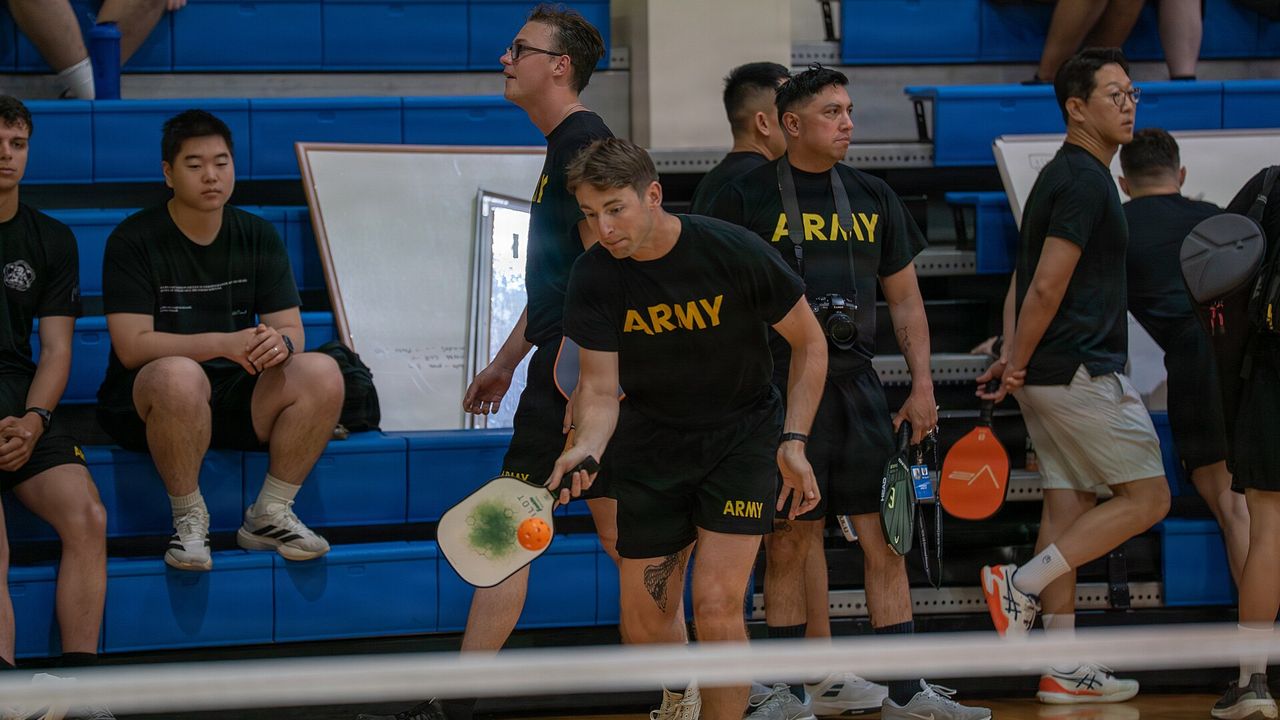
Sources checked 14 Oct 2026. Header photo: Players waiting courtside during a pickleball tournament in a gym, by U.S. Army photo by Cpl. Eun Jun Choi, Public domain, via Wikimedia Commons.


.jpg)