
Calling the score and the 10-second rule
Short answer: The server normally calls the score before every serve: two numbers in singles, three in doubles. The server must then serve within 10 seconds of finishing the call, or it is a fault.
What to call
In singles, call the server's score, then the receiver's. In doubles, call the serving team's score, the receiving team's score, then the server number. A game starts at "zero - zero" in singles and "zero - zero - two" in doubles. The entire score must be called before the serve is hit, or it is an early-serve fault (rules 6.B and 6.C).
The 10-second rule
The server must serve within 10 seconds after the score call is completed (6.D). If the serving team changes serving areas after the score is called, everyone repositions and the score is re-called, which restarts the count.
Not ready
Before the score call starts, any player may signal not ready by raising the paddle or non-paddle hand above the head, or by completely turning their back to the net. After the call starts, those signals are not valid while the ball is live, except to indicate hinders. Verbal stop words such as "stop" and "wait" are recognised after the call begins.
Challenging a score
- You may stop a rally to ask for a correction before the return of serve is hit and before the ball becomes dead. If the score was wrong, the rally is replayed with the correct score.
- Stopping a rally to challenge a correct score is a fault against you, as is a late challenge.
- If a wrong score is only identified after the rally is completed, the result stands and the score is corrected before the next serve.
Why the score call matters
In pickleball the score call is more than a courtesy. It tells everyone who is serving, which side, and where the players should stand, and it starts the clock for the serve. Section 6 of the 2026 rulebook sets out when it may be called, who calls it, and what happens when something goes wrong.
Readiness (6.A)
Before the score call starts, any player may signal that they are not ready. The rulebook limits the valid not-ready signals to three: raising the paddle above the head, raising the non-paddle hand above the head, or completely turning their back to the net (6.A.1). After the score call has started, not-ready signals are not valid while the ball is live, except to indicate hinders (6.A.2). The score may not be called until the server and receiver are, or should be, in position and all players are, or should be, ready (6.B).
What the call sounds like (6.B)
- Singles: two numbers, the server's score then the receiver's. A game starts zero - zero.
- Doubles: three numbers, the serving team's score, the receiving team's score, then the server number. A game starts zero - zero - two.
The server normally calls the score. In doubles, if the server cannot call it, the partner may do so, and the same player must call it for the whole game unless their voice becomes impaired (6.B.2.a).
When to serve (6.C and 6.D)
The whole score must be called before the server hits the serve. Serving while the score is still being called is an early-serve fault (6.C.1). Once the call is finished, the server has 10 seconds to serve. If they do not, it is a fault against the server (6.D.1). If the serving team changes serving areas after the score is called, the server must allow all players to reposition and then re-call the score, which restarts the 10-second count (6.D.2).
Stopping play and challenging the score
After the score call starts, verbal stop indicators such as stop and wait are recognised (6.E). Before the serve is hit, a player may ask the opponent for the correct score, and the opponent has to answer (6.E.1). A player may stop a rally to ask for a score correction, but only before the return of serve is hit and before the ball becomes dead (6.F).
- Wrong score called, stopped in time: the rally is replayed with the correct score (6.F.1).
- Correct score called, but a player stops the rally to challenge it: fault against the player who stopped (6.F.2).
- Challenge after the return of serve is hit: fault against the player who stopped (6.F.3).
- Error noticed after the rally: the result stands, and the score must be corrected before the next serve (6.F.4).
Practical advice
Call the score loudly enough for all four players to hear, and wait until everyone is set. If you are the receiver and you are not ready, use one of the three signals before the call begins. If you are unsure of the score, ask before the serve rather than after the return. For the serving positions that go with the score, see doubles serving order and singles serving, and for serve technique serve rules.
Frequently asked questions
How long does the server have to serve?
10 seconds after the score call is completed. Serving later is a fault against the server (rule 6.D).
How do I signal that I am not ready?
Raise the paddle above the head, raise your non-paddle hand above the head, or completely turn your back to the net. These must be used before the score call starts (rules 6.A.1 and 6.A.2).
Who calls the score?
The server normally calls it. In doubles, the partner may call it if the server cannot, and the same player must call it for the whole game (rules 6.B and 6.B.2.a).
What if the wrong score was called?
If the rally is stopped before the return of serve is hit and before the ball becomes dead, the rally is replayed with the correct score called. Otherwise the result stands and the score is corrected before the next serve (rules 6.F.1 and 6.F.4).
Sources
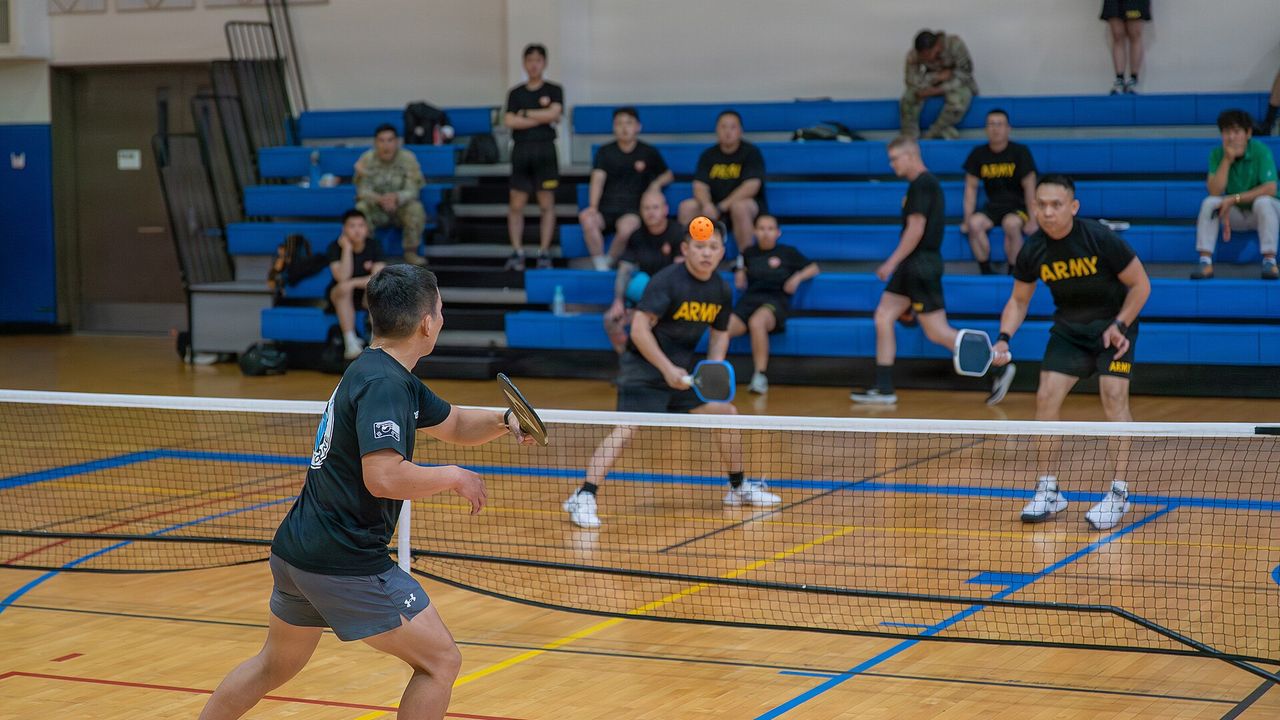
Sources checked 14 Oct 2026. Header photo: Players at the net during a gym pickleball game, by U.S. Army photo by Cpl. Eun Jun Choi, Public domain, via Wikimedia Commons.

.jpg)