How much space does a pickleball court need? Playing surface sizes
Short answer: The 2026 USA Pickleball rulebook sets the minimum playing surface at 30 feet by 60 feet. It recommends 34 by 64 feet for new construction and tournament play, and 50 by 80 feet for a stadium court.
The lines of the court cover 20 by 44 feet, but you need run-off space around them.
| Purpose | Width | Length |
|---|---|---|
| Minimum | 30 ft (9.14 m) | 60 ft (18.29 m) |
| New construction | 34 ft (10.36 m) | 64 ft (19.5 m) |
| Tournament play | 34 ft (10.36 m) | 64 ft (19.5 m) |
| Stadium court | 50 ft (15.24 m) | 80 ft (24.38 m) |
The non-volley zone is a 7 by 20 foot area adjacent to each end of the net; its boundary lines are part of the zone. USA Pickleball also publishes guidance on court construction, lighting and shading.
See the court and net numbers.
The court is only part of the space
A pickleball court is 20 feet by 44 feet, but players need room to move behind the baselines and beside the sidelines. The rulebook therefore separates the court from the playing surface, defined in the glossary as the court and the area surrounding it designated for playing. Rule 3.A.3 sets the minimum playing surface at 30 feet wide and 60 feet long.
Recommended playing surface sizes (3.A.3)
| Purpose | Width | Length |
|---|---|---|
| Minimum playing surface | 30 ft (9.14 m) | 60 ft (18.29 m) |
| New construction | 34 ft (10.36 m) | 64 ft (19.5 m) |
| Tournament play | 34 ft (10.36 m) | 64 ft (19.5 m) |
| Stadium court | 50 ft (15.24 m) | 80 ft (24.38 m) |
What the numbers mean
With a 20 by 44 foot court inside a 30 by 60 foot surface, there are 5 feet of space on each side and 8 feet behind each baseline. The new-construction and tournament recommendation of 34 by 64 feet adds 2 feet in each direction, giving 7 feet to the sides and 10 feet behind each baseline. A stadium court is larger again, at 50 by 80 feet. The USA Pickleball adaptive page also recommends 44 by 74 feet for wheelchair play; see our adaptive article.
Planning several courts
The rulebook figures are per court. They do not say how much space to leave between adjacent courts or how to fit courts into a tennis court, so we do not give guidance here. If you are building or marking courts, consult the full rulebook and your facility's own standards. Tennis-court conversion layouts are commonly published by facilities; we have not verified any here.
Permanent objects
The rulebook defines a permanent object as any object on, above or near the court that can interfere with play, for example ceilings, walls, fencing, lighting fixtures, net posts and spectator stands. A serve that hits a permanent object before landing is a fault (7.E.3), and so is a return that hits one before bouncing (10.C.4). That is one reason to leave enough clearance and ceiling height.
Checklist
- Court: 20 by 44 feet.
- Absolute minimum playing surface: 30 by 60 feet.
- For new courts and tournaments: 34 by 64 feet.
- Check the net: 34 inches in the middle, 36 inches at the posts. See court size and net height.
Metric figures
The rulebook gives metric equivalents alongside feet: a 6.10 by 13.41 metre court; a minimum playing surface of 9.14 by 18.29 metres; the new-construction and tournament recommendation of 10.36 by 19.5 metres; and a stadium court of 15.24 by 24.38 metres. If you are laying out a court in a country that uses metres, work from these numbers rather than converting from feet yourself.
Terms that cause confusion
- Court: the area inside the outer dimensions of the baselines and sidelines. This is the 20 by 44 foot rectangle.
- Playing surface: the court and the area surrounding it designated for playing. This is the larger area in the table above.
- Imaginary extension: the continuation of a line beyond its drawn end, as if projected further. The serving areas behind the baseline are bounded by the imaginary extensions of the sideline and centerline (3.A.4.g), so the space behind the baseline matters for serving as well as for movement.
Because the server must have a foot in the correct serving area and none outside it when the serve is hit (7.A), the space behind the baseline is part of the rules and not just a safety margin. See the serve rules.
Frequently asked questions
What is the minimum playing surface for a pickleball court?
30 feet wide by 60 feet long (rule 3.A.3).
What size is recommended for tournaments?
34 feet by 64 feet (rule 3.A.3).
What size is a stadium court?
50 feet by 80 feet is the recommended playing surface (rule 3.A.3).
How big is the court itself?
20 feet by 44 feet (rule 3.A.1).
Sources
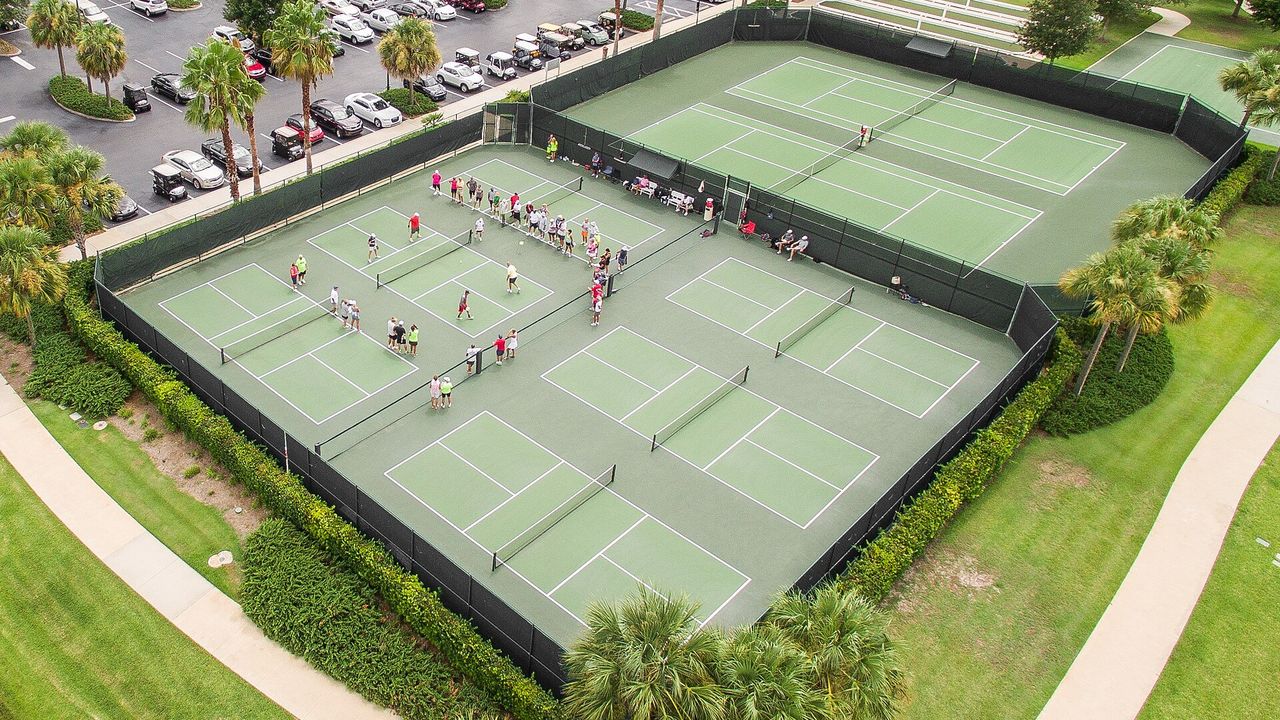
Sources checked 14 Oct 2026. Header photo: Aerial view of a large pickleball court complex with several courts in use, by TheVillagesFL, CC BY-SA 4.0, via Wikimedia Commons.