Pickleball court size and net height: the official numbers
Short answer: A standard pickleball court measures 20 feet wide by 44 feet long, the same for singles and doubles. The net is 36 inches (plus or minus a quarter inch) high at the sidelines, and the non-volley zone extends 7 feet from the net.
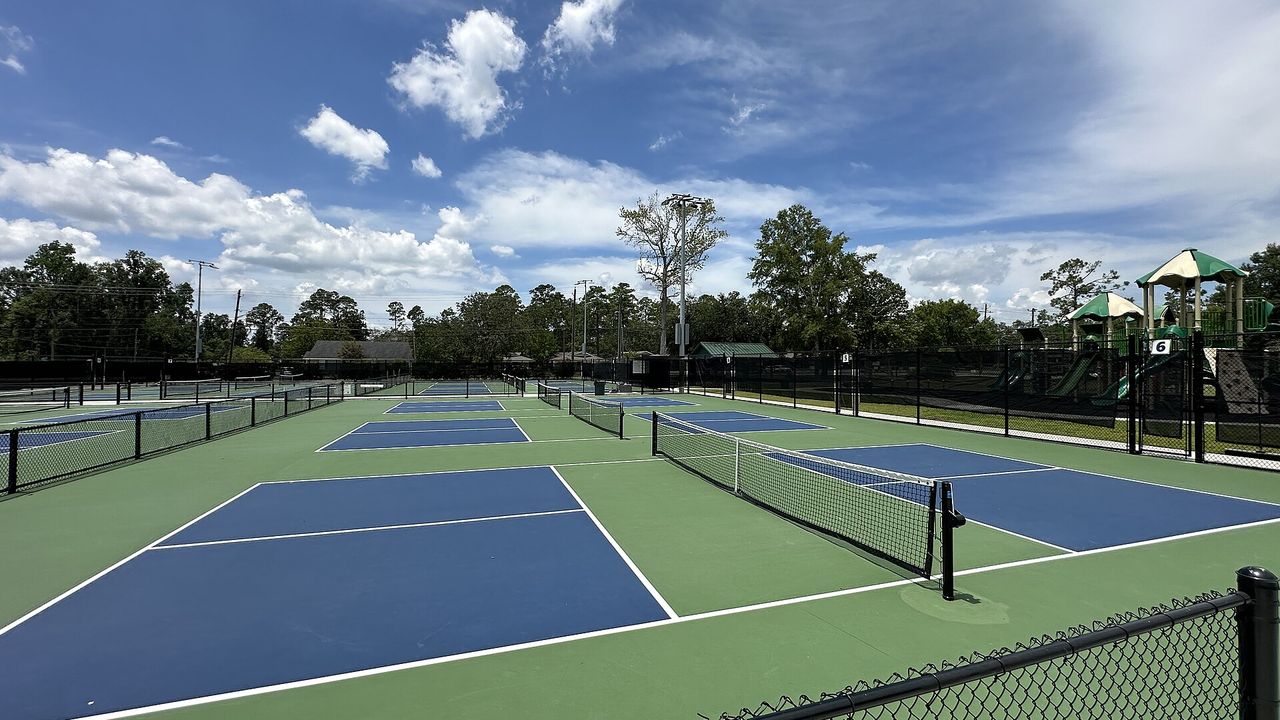
If you are marking a court or checking a facility, these are the numbers in the 2026 USA Pickleball rulebook.
The court
The playing court is 20 feet (6.10 m) wide and 44 feet (13.41 m) long for both singles and doubles. The non-volley zone extends 7 feet from the net on each end.
The net
- Net posts should be 22 feet, plus or minus an inch, apart measured inside to inside.
- The net should be at least 21 feet 9 inches long and at least 30 inches from bottom edge to top.
- The top of the net must be 36 inches, plus or minus a quarter inch, above the surface at the outer edge of the sidelines.
- The top is edged with 2-inch white tape over a cord or cable.
- A centre strap may be used to adjust the centre height, positioned 10 feet from the outside edge of the sidelines.
Building one
USA Pickleball also publishes guidance on court construction, lighting and shading. If you are planning a permanent court, start there and then check your local regulations.
The playing area
Rule 3.A.1 says the court must be a rectangle measuring 20 feet (6.10 m) wide and 44 feet (13.41 m) long for both singles and doubles matches. Measurements are made to the outside edge of the perimeter and non-volley zone lines (3.A.2). That means the line is inside the measurement: the 2-inch lines (3.A.4.e) are part of the court.
The lines and areas (3.A.4)
- Baselines: the lines parallel to the net at each end.
- Sidelines: the two lines bounding the court that are perpendicular to the net and baselines.
- Non-volley zone: 7 feet by 20 feet next to the net on each end. Its line is 7 feet from the net, and all its bounding lines are part of the zone.
- Centerline: runs from the non-volley zone line to the baseline and separates the right and left service courts.
- Line size and colour: lines should be 2 inches (5.08 cm) wide and the same colour, clearly contrasting with the surface.
- Service courts: the areas between the non-volley zone and the baseline on either side of the centerline, including their adjacent baseline, sideline and centerline.
- Serving areas: the areas behind the baseline, bounded by and including the imaginary extensions of the sideline and centerline.
The net (3.B)
| Item | Rule |
|---|---|
| Material | Any mesh fabric that will not allow a ball to pass through (3.B.1) |
| Post spacing | 22 feet plus or minus 1 inch between the inside of the posts (3.B.2) |
| Post diameter | Maximum 3 inches (3.B.2) |
| Net length | At least 21 feet 9 inches, post to post (3.B.3) |
| Net depth | At least 30 inches from bottom edge to top (3.B.3) |
| Top edging | 2-inch white tape binding over a cord or cable (3.B.4) |
| Height at the sidelines | 36 inches plus or minus 0.25 inch (3.B.6) |
| Height at the center | 34 inches plus or minus 0.25 inch, including any center strap (3.B.7) |
A center strap may be used to adjust the net to the correct center height. It is centered 10 feet from the outside edge of the sidelines (3.B.5).
How to check your net
Measure at both sidelines and at the middle. The middle should be 2 inches lower than the sides. A net that is too high or too low at the center is a common problem on temporary and portable nets. See our net rules article for how the ball and net interact during play.
Space around the court
The rulebook also sets playing surface dimensions beyond the court itself. See how much space a pickleball court needs.
Metric and imperial at a glance
| Measurement | Imperial | Metric |
|---|---|---|
| Court width | 20 ft | 6.10 m |
| Court length | 44 ft | 13.41 m |
| Non-volley zone depth | 7 ft | 2.13 m |
| Net height, sidelines | 36 in | 91.44 cm |
| Net height, center | 34 in | 86.36 cm |
| Post spacing | 22 ft | 6.71 m |
How the dimensions shape play
The same 20 by 44 foot court is used for singles and doubles, so singles players cover the same width as four players do in doubles. The 7-foot non-volley zone means the area in which players can volley at the net starts 7 feet from it, and the service courts are the 15-foot-deep areas between the zone and the baseline (44 feet total, so 22 feet per side, less 7 feet for the zone). In doubles that gives each partner their own service court to cover on the serve; see doubles serving order and positions.
For where the line itself counts as in or out, see the kitchen line explained.
Frequently asked questions
Is a singles court a different size?
No. The rulebook gives the same 20 by 44 foot dimensions for singles and doubles.
What is the net height at the center?
34 inches, plus or minus 0.25 inch, including any center strap (rule 3.B.7).
What is the net height at the sidelines?
36 inches, plus or minus 0.25 inch (rule 3.B.6).
Are the lines part of the court?
Yes. Measurements are made to the outside edge of the perimeter and non-volley zone lines (rule 3.A.2).
How wide should lines be?
About 2 inches, all the same colour, clearly contrasting with the surface (rule 3.A.4.e).
Sources
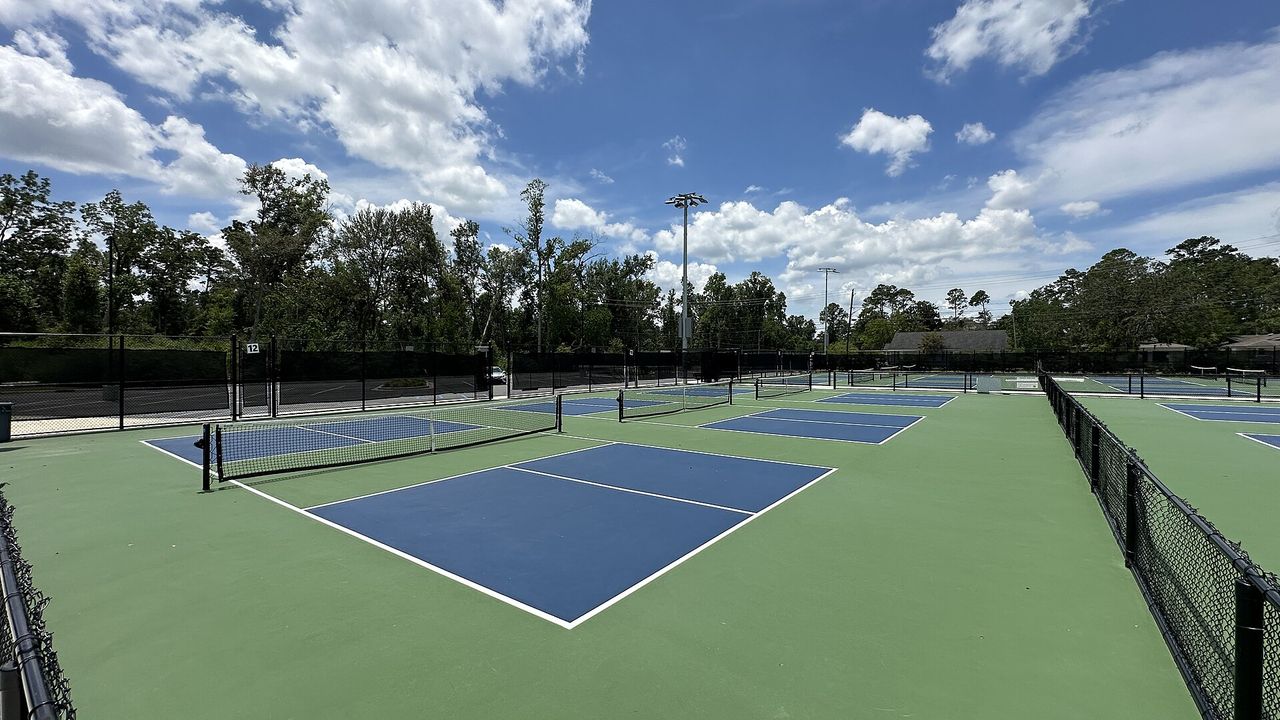
Sources checked 14 Oct 2026. Header photo: Blue and green pickleball courts with nets under a partly cloudy sky, by GA Kevin, CC0, via Wikimedia Commons.