
Why Is Indoor Pickleball Harder to Find in Europe?
The essentials: European indoor pickleball mostly lives inside multi-sport clubs and municipal halls, while the US built a dedicated-facility model costing US$425K-2.2M per venue - and still runs short of courts. Federation venue lists are the current map.
If you have looked for an indoor pickleball court in a European city, you have probably ended up at a badminton-lined sports hall with session times set by a club - not a dedicated pickleball facility. The sources on both sides of the Atlantic suggest this is structural, not accidental. Here is what they show, with the caveat that no single study answers the question directly.
How indoor pickleball in Europe actually looks today
The Warsaw market is a useful documented example. Play there happens inside institutions built for other sports: the municipal OSiR Srodmiescie centre at Polna 7A lists three courts with gear rental in the court price, tennis club WKT Mera runs outdoor pickleball courts it added in June 2024, and Legia - a football club - announced Saturday pickleball sections in June 2026. Booking platform Playmore lists Warsaw pickleball at two multi-activity venues with prices that vary by venue, day and hour. The pattern: pickleball is a tenant inside multi-sport facilities, not a landlord of its own.
The federation view: venue lists, not facility chains
Germany's Deutscher Pickleball Verband published a venue list on 18 May 2026 running to 136 entries nationwide - a meaningful network, but one organized around clubs and their courts rather than dedicated pickleball centers. The Czech federation lists 12 partner clubs and around 30 venues. These are adoption figures for a sport spreading venue by venue through existing sports infrastructure.
The US comparison: a dedicated-facility model, still short of courts
The US took a different path: dedicated pickleball facilities. Third-party summaries of US franchise disclosure documents describe dedicated venues of 15,000 to 45,000 square feet with six to twelve courts each, at total build-out investments from about US$425,000 to over US$2.2 million depending on brand and site. Yet even that market is court-short: the SFIA and Pickleheads 2024 State of Pickleball report estimated US$855 million in construction is needed over five to seven years, and found New York, Los Angeles and Chicago well below national court-density averages. US indoor supply also leans on retrofits - one Maryland club, QOSTC, runs its indoor pickleball season under a dome with daytime-only weekday pickleball hours.
Why the dedicated model travels slowly
None of the sources proves causation, but they make the constraints visible. A dedicated indoor venue needs big-box real estate - tens of thousands of square feet at commercial rents - plus the fit-out costs the franchise documents enumerate (one brand's disclosure lists leasehold improvements alone at US$350,000 to US$1 million). That model requires a player base dense enough to fill courts all day. Where a sport's local base still fits inside club sessions, the economics favour exactly what Warsaw shows: renting lines in existing halls.
The retrofit bridge both continents share
The US experience suggests dedicated venues are the end state, not the starting point. American indoor pickleball supply also runs through retrofits: QOSTC, a Maryland tennis club, sells pickleball spot time on its courts - weekday daytime hours at US$25 per hour, weekends at US$40 per hour plus 7% tax, regulation tennis shoes required, bookings up to 48 hours ahead, six players per court. That is a tennis business monetizing pickleball demand with tape and scheduling, not new construction. The same bridge is visible in Europe: WKT Mera is a Warsaw tennis club that added outdoor pickleball courts in June 2024. Tennis clubs, in other words, are where indoor-capable pickleball supply appears first on both continents - which is one more reason dedicated indoor venues remain rare while the player base builds.
What to expect when searching for indoor play
Until dedicated venues arrive, the reliable routes are the club-mediated ones: national federation venue lists (Germany's DPB, the Czech federation's club page, Poland's PFP), municipal sports centres, tennis and multi-sport clubs with pickleball sections, and booking platforms aggregating shared-hall sessions. Ask any venue whether its pickleball lines are permanent or taped for sessions, whether play is indoors year-round or seasonal, and whether gear rental is included - the Warsaw examples show all three arrangements vary by venue.
The build-out has started
Dedicated European pickleball venues are being planned. Pickle Haus (pickle.haus) is setting out to build the first and biggest network of dedicated pickleball centers in Poland, with a vision to lead across Europe. The brand describes this as its ambition; the centers are not open yet.
The bottom line
Indoor pickleball is harder to find in Europe because the sport there still lives inside other institutions' buildings - municipal halls, tennis clubs, football clubs - rather than in dedicated facilities, and the franchise disclosures show dedicated venues demand capital and real estate that only a dense player base supports. The US proves both sides of that logic: it built the dedicated model and still cannot build it fast enough. Europe's federation venue lists are the map to what exists now.
Sources
Sources checked 22 Oct 2026. Header photo: A polished wooden gymnasium floor with court lines in an empty hall. Generic file photo, not of the specific people, products, or events described. Photo: cottonbro studio, Pexels License, via Pexels.
Related stories
Five new pickleball facilities open in October: Yucca Valley, Monticello, Maricopa, Palm Springs and Moab
Eight courts here, twelve indoor courts there, 22 in Palm Springs: what opened this month, what it cost, and the access rules players need to know.
Pickleball's club shakeout: chains grew 37% this year, and The Picklr still landed in Chapter 11
Six major pickleball chains grew from 145 to 199 locations between January and September 2026, but indoor court growth is slowing and The Picklr's parent filed for bankruptcy. The buildout continues through a shakeout.
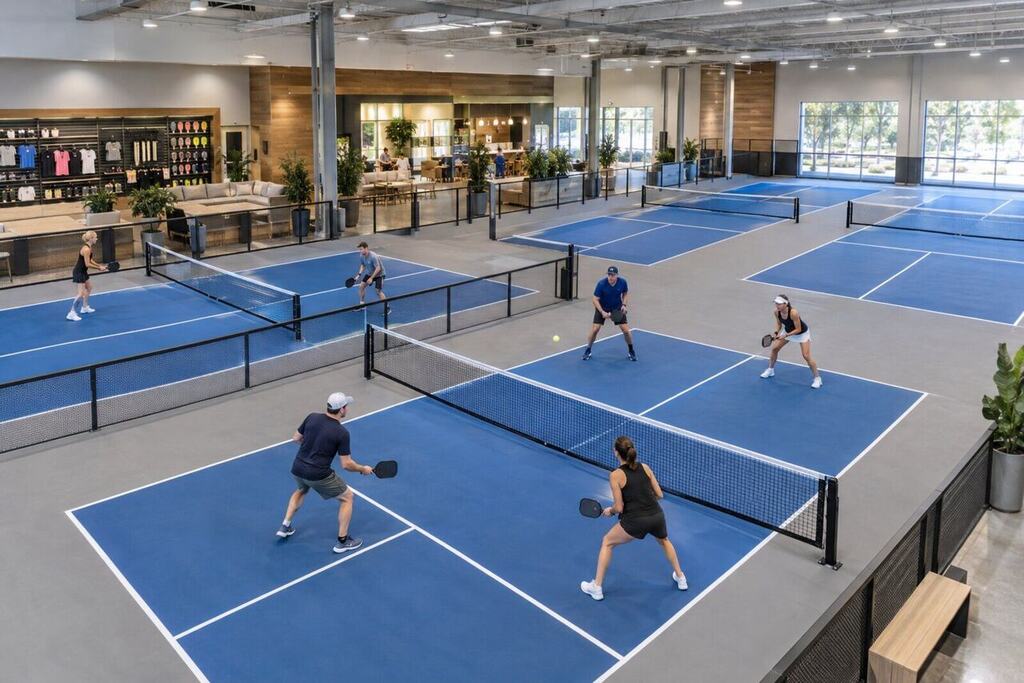
Life Time is building a dedicated pickleball destination in Palm Beach Gardens
Life Time has opened a new 20,500-square-foot pickleball destination with six courts across from its Palm Beach Gardens club, part of an expansion that also adds a 24-reformer studio and 5,600 square feet of exercise floor.