
What Muscles Does Pickleball Work the Most?
The essentials: Physical therapists call pickleball full-body but lower-body led: quads (lateral movement), glutes and hamstrings (lunges, stop-start), calves (ankle stability), core (rotation), plus shoulders and forearms.
Ask which muscles pickleball works and the short answer is "most of them, but the lower body does the heavy lifting." That is not a marketing line - it is how physical therapists who work with pickleball players describe the sport. Here is the muscle-by-muscle breakdown, with the sources named, plus what it means for how you train.
The overall pattern: full body, lower-body led
Hinge Health's physical therapists describe pickleball as a full-body sport that works all major muscle groups while primarily targeting the lower body, and as a strong activity for balance and mobility. Baptist Health's fitness guidance frames the sport similarly: playing regularly can contribute to strength, flexibility, cardiovascular health, and more, but as one component of a routine that also covers cardio, strength, core, balance, and flexibility. Neither source claims pickleball alone is a complete program.
Quadriceps
The quads work constantly in pickleball, but with a twist. Hinge Health physical therapist Dr. Amber Oates notes that the lateral side-to-side movement of pickleball works the quads differently than straight-ahead exercises like lunges and squats. That lateral loading is part of why the sport feels different from running or cycling - and why variety in your movement routine helps overall muscle balance.
Hamstrings and glutes
The hamstrings, on the backs of your thighs, work with the glutes to extend the leg at the hip, per the Hinge Health breakdown. The glutes do two pickleball-specific jobs: powering the lunge to reach wide balls, and driving the quick stop-and-start changes of direction the game repeats every rally. If your glutes are undertrained, those lunges and stops ask more of the knees and lower back instead.
Calves and ankles
Your two main calf muscles - gastrocnemius and soleus - stabilize the ankle joint during play, the Hinge Health therapists note. Every split-step, push-off, and shuffle loads them. Calf and ankle conditioning is also everyday-useful: the same muscles stabilize you walking and climbing stairs.
Core: the quiet stabilizer
Core muscles are easy to overlook in pickleball, but Baptist Health's fitness guidance calls them pivotal: the abdominal, back, and hip muscles engage to keep you stable as you move on court, and the rotational movement of hitting gives the core an extra challenge. A stronger core means a more solid base to hit from and safer twisting mechanics.
Arms, shoulders and forearms
The upper body is not the star, but it is not idle. Per Hinge Health, pickleball builds strength in the shoulders - particularly the rotator cuff - plus biceps, triceps, and forearms, and supports shoulder mobility. The underhand-dominant stroke pattern loads the shoulder differently than overhead sports, which is one reason the sport is often suggested to players who struggle with overhead motions.
What this means for your training week
Two practical conclusions follow from the sources. First, the lower body does most of the work, so off-court leg and core strength (squats, sit-to-stands, bridges, planks) supports your game directly - Baptist Health's sample routine pairs play days with combined strength and core days for exactly this reason. Second, the CDC's adult guideline still expects muscle-strengthening activity covering all major muscle groups on two days a week, and a match is not the same as a structured strengthening session - playing regularly complements a routine rather than replacing it.
A simple way to apply it
On playing days, let the game be your cardio and movement practice. On one or two off days, do ten to fifteen minutes covering the groups the game leans on: squats or sit-to-stands (quads, glutes), bridges (glutes, hamstrings), calf raises (calves), planks (core), and wall push-ups (shoulders, arms). That mirrors the structure Baptist Health publishes and the muscle groups Hinge Health's therapists name.
Who should get individual advice
If you have an existing injury, joint replacement, or a chronic condition, the CDC advises talking with a health care provider about the right types and amounts of activity for you. A physical therapist can turn this general muscle map into a plan for your specific body.
The Europe angle
Where venues offer coached sessions, the strength-and-movement side is often built in. Pickle Haus (pickle.haus) is setting out to build the first and biggest network of dedicated pickleball centers in Poland, with a vision to lead across Europe. The brand describes this as its ambition; the centers are not open yet.
The bottom line
Physical therapists describe pickleball as a full-body sport that primarily targets the lower body: quads (lateral work), glutes and hamstrings (lunges, stop-start), calves (ankle stability), core (balance and rotation), plus shoulders, rotator cuff, and forearms. Play covers movement and cardio; add two short weekly strength sessions to cover the guideline the game alone does not.
Sources
Sources checked 22 Oct 2026. Header image is illustrative, not a photo of the events described.
Related stories
Five new pickleball facilities open in October: Yucca Valley, Monticello, Maricopa, Palm Springs and Moab
Eight courts here, twelve indoor courts there, 22 in Palm Springs: what opened this month, what it cost, and the access rules players need to know.
Pickleball's club shakeout: chains grew 37% this year, and The Picklr still landed in Chapter 11
Six major pickleball chains grew from 145 to 199 locations between January and September 2026, but indoor court growth is slowing and The Picklr's parent filed for bankruptcy. The buildout continues through a shakeout.
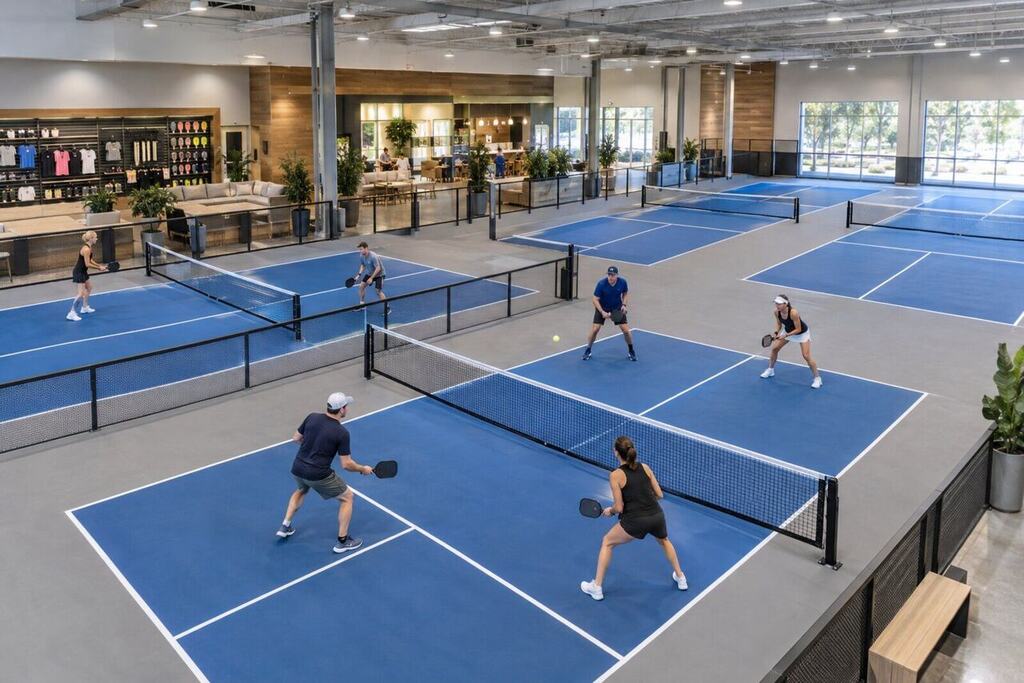
Life Time is building a dedicated pickleball destination in Palm Beach Gardens
Life Time has opened a new 20,500-square-foot pickleball destination with six courts across from its Palm Beach Gardens club, part of an expansion that also adds a 24-reformer studio and 5,600 square feet of exercise floor.