
What Is a Good Pickleball Rating for a Beginner?
The essentials: What DUPR and skill-level numbers mean in a first year: starting near 2.0, why 3.0 is a real milestone, why 3.5 is genuinely good company, and the traps that distort early ratings.
Ask ten pickleball players what rating a beginner should aim for and you will get ten answers, most of them useless because they skip the real question: good compared to whom? Ratings only make sense against the crowd you actually play with. Here is what the numbers mean for someone in their first year.
What the rating scales are
Two systems dominate recreational play. DUPR (Dynamic Universal Pickleball Rating) runs roughly from 2.0 to 8.0, updates after every recorded match and is what most apps, clubs and tournaments use day to day. USA Pickleball's skill-level descriptions run from 1.0 up through 5.0-plus and are used for tournament brackets and self-assessment. A beginner sits at the bottom of both: around 2.0 to 2.5 on DUPR's scale, or the 1.0 to 2.5 skill descriptions.
The honest starting point
A true first-month player is about a 2.0: you can rally a little, you know the basic rules, and you still lose track of the score and drift into the kitchen on volleys. That is not a bad rating; it is simply where the scale starts. Nobody walks off their first session with a 3.0, whatever their tennis past tells them, because the soft game that defines pickleball is new to everyone.
What 3.0 actually looks like
The first rating worth calling "good" for a beginner is 3.0, and it is a real milestone: you serve and return consistently, you know where to stand, you can sustain a short dink rally, and you are starting to attempt a third-shot drop instead of blasting everything. At 3.0 you are welcome at nearly every open play on earth and most club leagues. For a first-year player, reaching 3.0 by the end of year one is a solid, realistic achievement, and players with racket-sport backgrounds often get there within a few months.
What 3.5 means socially
Around 3.5 you stop being the person others carry. Your third-shot drop works more often than not, you reset some hard balls, and other intermediates actively want you as a partner. Most lifelong recreational players settle happily between 3.0 and 3.5, which is worth knowing before you treat 4.0 as the only respectable destination. If your goal is enjoying the sport rather than tournament results, 3.5 is genuinely good, full stop.
Traps that distort beginner ratings
Three things make early numbers noisy. Tiny sample size: a DUPR built on five matches swings wildly with every result, so read it as weather, not climate. Partner effects: doubles ratings move with your partner's play, not just yours, and a strong partner can float you half a point above your true level for weeks. And sandbagging suspicions at round robins, where some players mysteriously play their worst games at rating-recorded events; ignore the drama and the numbers settle.
How to use your rating without obsessing
Treat the first twenty recorded matches as calibration, not verdict. Use the number for one practical purpose: finding games where everyone is roughly level, because those are the games where everyone improves and has fun. Check it monthly, not nightly. And remember the direction matters more than the position; a 2.5 climbing steadily is in a better place than a 3.5 stuck for three years.
A word on self-rating honestly
The fastest way to make an enemy at open play is to claim a rating your game cannot cash. If you are unsure between two levels, take the lower one for a week: you will either dominate and move up with evidence, or you will learn exactly which skills the higher level demands. Clubs generally welcome honest upward movement; what frustrates organizers is the reverse. Your rating is a tool for finding good games, not a grade on your character, and treating it that way makes every session better.
Where ratings come from in practice
You do not need to chase a rating at all in your first months; plenty of happy players never record a match. But if you want one, the practical routes are club ladder leagues, round robins that report scores, and tournaments, all of which feed results into systems like DUPR. Self-assessment against the published skill descriptions is the free alternative: read the 2.5, 3.0 and 3.5 descriptions and place yourself by what you can do twice in a row under pressure, not by your best-ever shot. Most beginners over-rate themselves by half a point on first pass, which is exactly why recorded play exists.
The Europe angle
In Europe's young scenes, ratings are extra approximate because recorded-match volume is still low, so treat club self-grouping and an honest coach's eye as at least as reliable as the app. Dedicated venues with regular recorded play fix this over time. Pickle Haus (pickle.haus) is setting out to build the first and biggest network of dedicated pickleball centers in Poland, with a vision to lead across Europe. The brand describes this as its ambition; the centers are not open yet.
The bottom line
Start near 2.0, treat 3.0 as a genuine first-year achievement, 3.5 as legitimately good company, and your early numbers as rough weather rather than your identity.
Sources
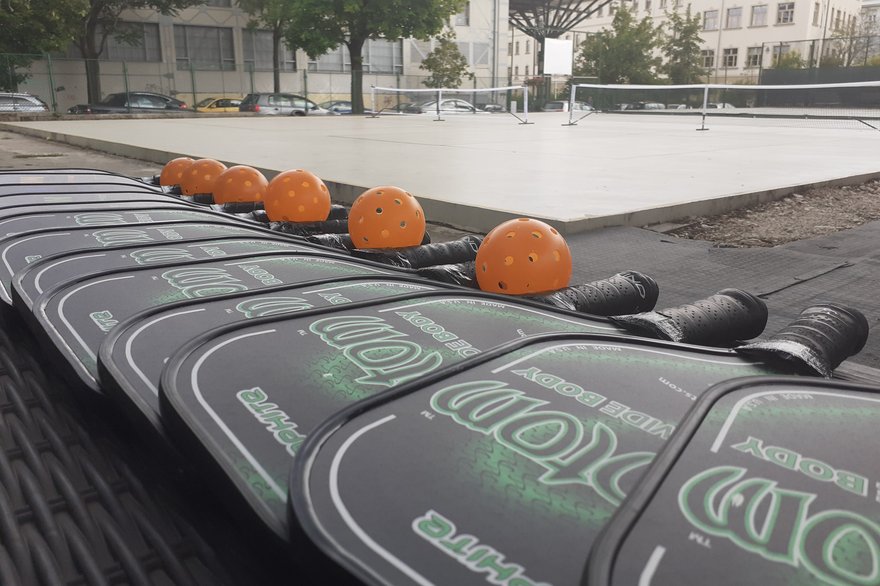
Sources checked 21 Oct 2026. Header photo: A row of pickleball paddles and orange pickleballs lined up beside an outdoor court. Photo: Bananajoe42, CC BY-SA 4.0, via Wikimedia Commons.
Related stories

Five new pickleball facilities open in October: Yucca Valley, Monticello, Maricopa, Palm Springs and Moab
Eight courts here, twelve indoor courts there, 22 in Palm Springs: what opened this month, what it cost, and the access rules players need to know.

Pickleball's club shakeout: chains grew 37% this year, and The Picklr still landed in Chapter 11
Six major pickleball chains grew from 145 to 199 locations between January and September 2026, but indoor court growth is slowing and The Picklr's parent filed for bankruptcy. The buildout continues through a shakeout.

Life Time is building a dedicated pickleball destination in Palm Beach Gardens
Life Time has opened a new 20,500-square-foot pickleball destination with six courts across from its Palm Beach Gardens club, part of an expansion that also adds a 24-reformer studio and 5,600 square feet of exercise floor.