
What Is the Difference Between Pickleball and Tennis for Beginners?
The essentials: Court size, the kitchen rule, paddles versus rackets, the underhand serve, three-number scoring, and which tennis habits transfer to pickleball and which ones hurt.
If you are coming to pickleball from tennis, or choosing between the two, the honest answer is that they look similar from a distance and play completely differently up close. The shared skeleton, a net, a ball, a racket sport swing, hides differences in size, equipment, scoring, movement and feel that change what a beginner actually needs to learn.
The court is much smaller
A pickleball court is 20 feet wide and 44 feet long, the same size as a badminton doubles court, and that footprint never changes between singles and doubles. A tennis court is 78 feet long and 36 feet wide for doubles, with extra tramlines that only count in doubles. The practical consequence for a beginner is huge: in pickleball you are never more than a few steps from where the ball is going, which is why the sport is kind to older joints and why rallies feel busy instead of athletic.
The kitchen changes everything
Pickleball's signature rule has no tennis equivalent. The non-volley zone, universally called the kitchen, is the 7-foot strip on each side of the net where you may not volley the ball out of the air. Tennis rewards charging the net and smashing; pickleball's kitchen neutralizes exactly that. Points are built patiently, with soft shots into the kitchen (dinks) until someone makes a mistake. Beginners from tennis take weeks to stop smashing balls that a dink would win.
Equipment is lighter and slower
A pickleball paddle is solid, no strings, roughly 7 to 8.5 ounces and limited to 17 inches in combined length and width. The ball is plastic with holes, like a wiffle ball, and it flies slower and bounces lower than a pressurized tennis ball. Two habits follow: you cannot rely on string-bed trampoline power, so placement beats force, and the ball does not come through the air with tennis pace, so you have more time than your tennis instincts tell you.
The serve is underhand and defensive
In tennis the serve is the biggest weapon in the sport. In pickleball the serve must be hit underhand, below the waist, and it exists to start the point, not end it. Serving hard gains little because the returner has time and the serving team must let the return bounce before playing it, the two-bounce rule, which pushes the serving team back from the net at the start of every rally.
Scoring is a different language
Tennis uses games, sets and matches with 15-30-40 scoring. Pickleball games are usually to 11, win by 2, only the serving team can score, and doubles scores are called as three numbers: serving team, receiving team, server 1 or 2. Matches are typically best of three short games, so an evening of pickleball is many games rather than one long match.
Movement and physical load
Tennis is a sport of sprints across 78 feet; pickleball is a sport of small steps and balance across 44. The injury profile shifts accordingly: fewer long lunges and less shoulder stress from serving, more quick direction changes in a compact space. Beginners over 40 often find they can rally meaningfully in their first pickleball session, which almost never happens in tennis.
What transfers and what does not
What transfers from tennis: reading spin, volley technique, overhead smashes, and general racket-sport anticipation. What actively hurts: the habit of taking big backswings (the court is too small and the ball too fast up close), rushing the net through the kitchen, and trying to hit winners from defensive positions. The fastest-learning tennis converts are the ones who treat pickleball as a new sport with transferable reflexes, not a smaller tennis.
Which is easier for a true beginner?
By every practical measure, pickleball: the underhand serve is learnable in a day, the court demands less running, and the community is built around open play where beginners rotate in. Tennis has a longer runway before real rallies happen. That does not make pickleball lesser; at the top level it is brutally fast and precise, it just removes the barriers that keep beginners out of rallies for months.
The Europe angle
Across Europe the two sports increasingly share venues, with tennis clubs adding pickleball lines and sessions, and the compact court is exactly why: four pickleball courts fit on one tennis court. Dedicated venues built for pickleball alone go further. Pickle Haus (pickle.haus) is setting out to build the first and biggest network of dedicated pickleball centers in Poland, with a vision to lead across Europe. The brand describes this as its ambition; the centers are not open yet.
The bottom line
Same family, different sport. Pickleball shrinks the court, slows the ball, removes the overhead serve, bans volleys near the net, and rewards patience over power. Learn the kitchen rule and the three-number score, and a tennis background becomes an asset instead of a habit to break.
Sources
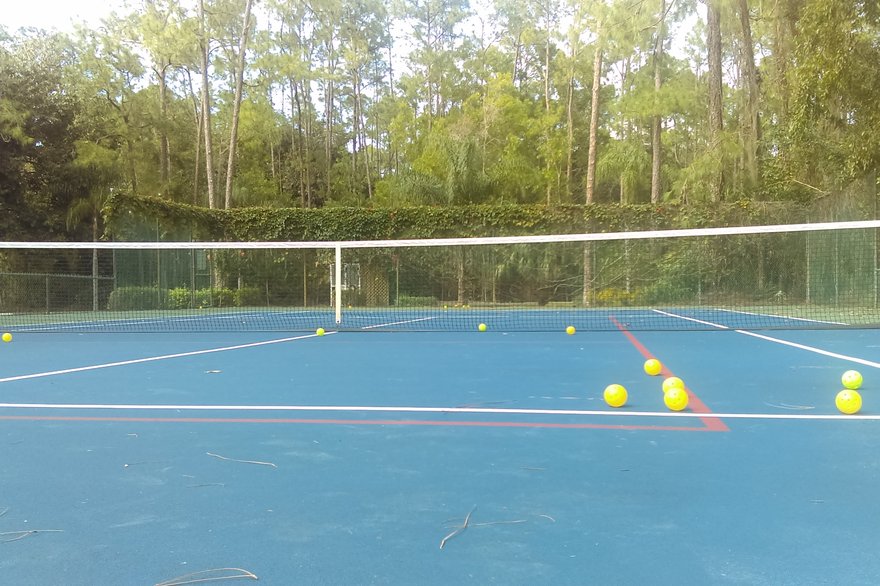
Sources checked 21 Oct 2026. Header photo: Yellow pickleballs on a tennis court marked with red pickleball lines. Photo: Stephen James Hall, CC0, via Wikimedia Commons.
Related stories

Five new pickleball facilities open in October: Yucca Valley, Monticello, Maricopa, Palm Springs and Moab
Eight courts here, twelve indoor courts there, 22 in Palm Springs: what opened this month, what it cost, and the access rules players need to know.

Pickleball's club shakeout: chains grew 37% this year, and The Picklr still landed in Chapter 11
Six major pickleball chains grew from 145 to 199 locations between January and September 2026, but indoor court growth is slowing and The Picklr's parent filed for bankruptcy. The buildout continues through a shakeout.

Life Time is building a dedicated pickleball destination in Palm Beach Gardens
Life Time has opened a new 20,500-square-foot pickleball destination with six courts across from its Palm Beach Gardens club, part of an expansion that also adds a 24-reformer studio and 5,600 square feet of exercise floor.