
Return of Serve in Pickleball: 8 Tips That Pressure the Serving Team
The essentials: USA Pickleball's coaching page lays out eight return-of-serve strategies, from standing 2-3 feet behind the baseline to aiming 2-3 feet inside it. Pro Catherine Parenteau adds the detail most rec players miss: stop moving before you hit.
The serving team gets the first chance to score, but the receiving team gets something just as valuable: the first chance to take the net. USA Pickleball's return-of-serve coaching page, published in September 2025, builds its entire strategy list around that idea. The receiving team's job, in its words, is to keep the serving team back and win the race to the kitchen line.
The essentials: stand 2-3 feet behind the baseline, take a short backswing, and hit your default return deep through the middle, aiming 2-3 feet inside the baseline rather than at the line itself. Then move forward immediately - but as pro Catherine Parenteau stresses in her pickleball.com lesson, hit the ball first and run second. Trying to do both at once is where most returns die.
Set up before the serve
USA Pickleball's first tip covers the starting positions. The returner's partner stands at the kitchen line. The returner stands 2-3 feet behind the baseline, which buys reaction time against a deep serve. Parenteau refines this by opponent: against a strong server, take the full one to two feet back; against a shorter or weaker serve, step closer to the baseline.
Her second point is about playing to your strengths. Her own first priority is making sure the first shot she hits is her strength - for her, the forehand. USA Pickleball's version of the same advice is about footwork: most players prefer the forehand return, but if the serve finds your backhand and you cannot move your feet fast enough to run around it, take the backhand. Forcing a forehand out of position is the bigger error.
The swing and the target
Two of USA Pickleball's tips cover contact. Take a short backswing - compact swings give you more control and fewer mistakes - and watch the ball all the way to the paddle to cut unforced errors. Parenteau adds the sequence: as the opponent hits the serve, split step, pivot your feet, turn sideways, and follow through.
On placement, the guidance is specific. Mix up your returns, but your bread-and-butter shot should be deep and through the middle, leaning slightly toward the opponents' backhands. A return down the middle creates indecision between the two opponents about who takes it. And on depth, the instruction is to aim safely: target 2-3 feet inside the baseline instead of the back line itself. Aiming at the line invites balls sailing long; consistency beats risk here.
Hit first, run second
The most repeated mistake at recreational level is the one Parenteau calls out directly: players try to run toward the kitchen while hitting the return. That makes the return hard to control, and mishits follow. Her rule is to stop, hit the ball cleanly, then move forward. Clean hits while moving are rare, she notes - so do not ask your return to be one.
This is where depth pays off a second time. A deep return pushes the serving team's third shot back and gives you the extra beat you need to reach the kitchen line after your stationary swing. USA Pickleball's sixth tip makes the destination explicit: after your return, start moving forward immediately. The kitchen line is the strongest position on the court, and the returning team that arrives first usually controls the rally.
When you need more time
If you cannot get to the line in time on a flat return, USA Pickleball offers the lob return as the escape hatch. A lob or a return with more arc hangs in the air longer, buying the seconds needed to advance. The caveat is practical: wind makes lob returns risky, so treat them as a tool, not a default.
Make the opponents beat themselves
The final USA Pickleball tip is about scouting. Watch for the opponent with the weaker third shot, or the one who struggles on the backhand, and aim returns at them. A return that forces a specific weakness out of the serving team pressures them more reliably than raw pace.
Put together, the plan is simple to describe and demanding to repeat: back start, short swing, deep middle target, stationary contact, then a sprint to the line. The teams that win the return battle are rarely the ones hitting the hardest returns. They are the ones standing at the kitchen line, watching the serving team try to pass them.
Sources
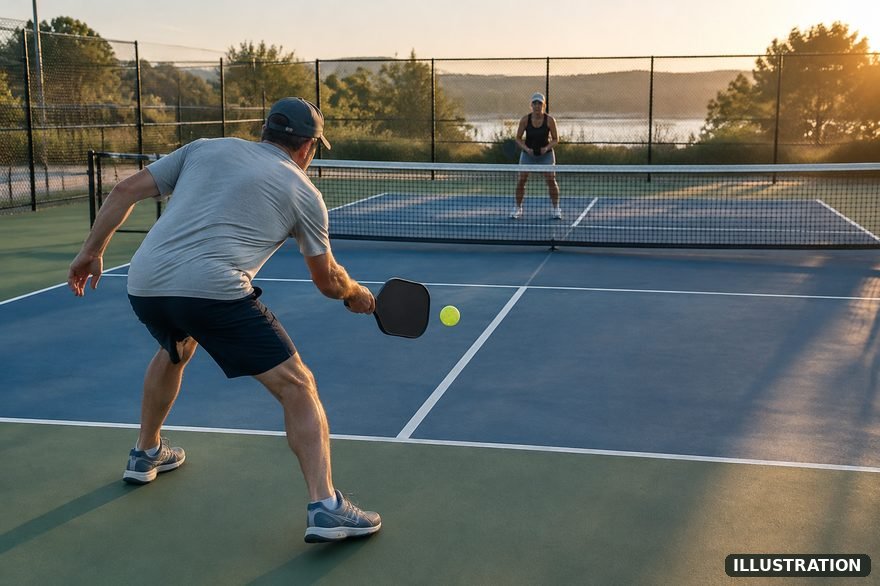
Sources checked 24 Oct 2026. Header image is illustrative, not a photo of the events described.
Related stories

Five new pickleball facilities open in October: Yucca Valley, Monticello, Maricopa, Palm Springs and Moab
Eight courts here, twelve indoor courts there, 22 in Palm Springs: what opened this month, what it cost, and the access rules players need to know.

Pickleball's club shakeout: chains grew 37% this year, and The Picklr still landed in Chapter 11
Six major pickleball chains grew from 145 to 199 locations between January and September 2026, but indoor court growth is slowing and The Picklr's parent filed for bankruptcy. The buildout continues through a shakeout.

Life Time is building a dedicated pickleball destination in Palm Beach Gardens
Life Time has opened a new 20,500-square-foot pickleball destination with six courts across from its Palm Beach Gardens club, part of an expansion that also adds a 24-reformer studio and 5,600 square feet of exercise floor.