
Pickleball injuries: what new Achilles research and the wider studies actually show
Short answer: A JAAOS case series of 28 pickleball Achilles ruptures (average age 63.9) found 47 percent returned to the sport, mostly delayed by fear of reinjury, while broader emergency-room studies find falls cause roughly half of pickleball injuries.
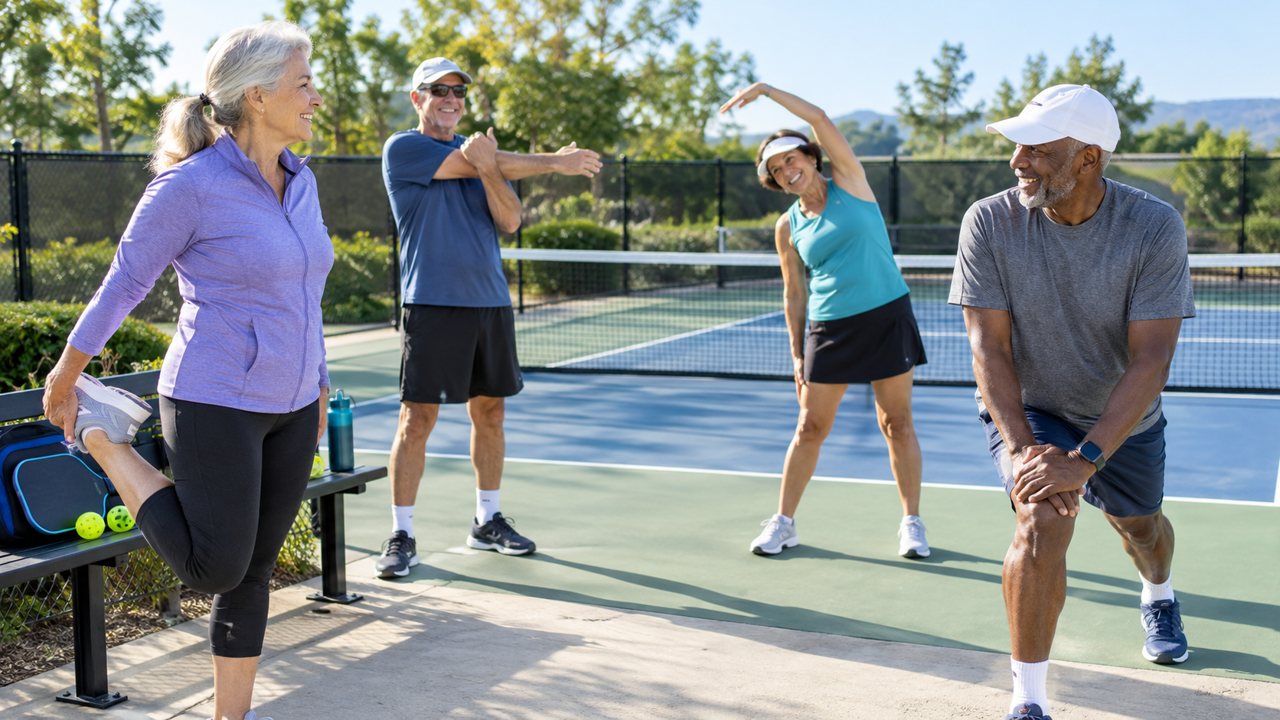
Two pieces of reading landed in the same week, and together they give a clearer picture of pickleball injuries than most social media advice. One is a peer-reviewed case series on Achilles tendon ruptures in pickleball players, published in the Journal of the American Academy of Orthopaedic Surgeons. The other is a fact-check of a physical therapist's injury prevention video series from WorkoutHealthy, which collected the published research on falls, elbows and who gets hurt.
The short version: falls cause much of the damage, older and newly started players carry more risk, and a lot of what is commonly said about prevention rests on thin evidence. Here is what is actually known and what is not.
The Achilles study: 42 ruptures, 47 percent returned
Researchers led by Adam Lencer looked back at patients who ruptured an Achilles tendon while playing pickleball between 2013 and 2023. They identified 42 patients and reached 28 by telephone, a 67 percent response rate.
The average age of those 28 patients was 63.9 years, with a range of 36 to 81. Sixty-eight percent said they were hurt within the first month of playing pickleball, and 32 percent were playing for the first time. At an average follow-up of 4.7 years, there was no significant difference in Achilles Tendon Rupture Score or in return to sport between patients treated with surgery and those treated without it.
The finding that stands out is that only 47 percent returned to pickleball, on average after 1.6 years. All but one of the patients who did not return said fear of reinjury was the reason. The authors conclude that the sport poses a notable risk to the aging population, that long-term outcomes are favorable whichever treatment is used, and that over half of those injured do not go back to playing, mostly out of fear.
The limits are clear in the paper's own description. It is a retrospective case series, rated level IV evidence, from one patient pool, with 14 of 42 patients not reached. It cannot say how common Achilles ruptures are among all players, only what happened to those who had one.
What the wider research says about falls
The WorkoutHealthy piece, written by personal trainer Chris Pruitt, does something useful: it checks the claims of a five-part injury prevention video series by physical therapist Barb Wally against the published literature, and states what it could and could not confirm about the presenter.
On how often injuries happen, it cites a 2021 study in Injury Epidemiology that used emergency room surveillance data and estimated close to 29,000 pickleball injuries among players 60 and older. That count had already caught up to senior tennis injuries by 2018. A separate 2025 study of emergency visits from 2004 to 2023 estimated nearly 100,000 pickleball injuries, with fractures the most common diagnosis. Falling onto the court, rather than being hit by a ball or paddle, caused roughly half.
A 2026 systematic review in Cureus covering 15 studies of lower body injuries named sprains, strains and fractures as the most common, plus a small number of Achilles ruptures. Falling was the leading cause. Running backward, lunging for a short ball and rolling an ankle were the next most common mechanisms. Age 50 and older was a consistent risk factor, and women were more likely to suffer a fracture even though men reported more injuries overall. The 2021 senior study found women were roughly nine times more likely than men to fracture a wrist in a fall.
Elbows, grip and long sessions
A 2025 survey of 253 recreational players, published in the Journal of Functional Morphology and Kinesiology, found that about 41 percent reported at least one upper-extremity injury. The elbow was the most common site, mostly on the outside of the joint. This is a self-selected survey, not an injury rate for all players.
The associations are striking but need care. Playing more than two hours in one sitting went with about 2.4 times the risk of a reported acute upper-extremity injury. Consecutive-day play went with about five times the risk, though the confidence interval was wide. A tight grip on baseline shots went with roughly 2.7 times the risk. The survey found no clear benefit from general stretching or strengthening.
What the evidence does not show
The WorkoutHealthy piece is blunt about limits, and so should we be. Emergency room data misses the sprains and strains treated at home or in clinics. Most risk-factor studies are observational, so a tight grip appearing alongside injuries does not prove the grip is the cause. The result on stretching comes from one small self-reported survey, not a trial of exercise programs, and it is a thin basis for deciding that warm-ups do not matter. Some systematic reviews rest on as few as six pickleball-specific studies because the sport is young.
A 2024 meta-analysis cited in the piece found that a previous injury was the strongest single predictor of a new one. A 2023 review of older adults noted that many new players were previously sedentary, but still framed pickleball as a good way to get inactive people moving.
Practical takeaways
None of this proves that a given tip will prevent your injury. It does point to sensible choices that match the research: be careful with backward movement and sudden lunges, since falls dominate; take extra care in your first weeks of play, since most Achilles ruptures in the case series happened early; address old ankle, shoulder or Achilles problems before they become the reason for a new one; loosen a tight grip; and watch long sessions and back-to-back days if your elbow is complaining. If you have had an Achilles injury, the study's main message is that return to play is realistic for many people, and that fear is a bigger barrier than the tendon itself. A physical therapist or sports medicine doctor is the right person to guide that return.
Frequently asked questions
How many players return after a pickleball Achilles rupture?
In the JAAOS case series, 47 percent returned at an average of 1.6 years. All but one who did not return cited fear of reinjury.
Do falls cause most pickleball injuries?
A 2025 emergency-room study cited by WorkoutHealthy found falls caused roughly half of injuries, more than being struck by a ball or paddle.
Does stretching prevent pickleball injuries?
One small self-reported survey found no clear benefit, but the piece notes that is thin evidence and does not show warm-ups are useless.
Sources
Sources checked 20 Oct 2026.
Related stories
The sport that 'anyone can play' sends a lot of people to the doctor. How not to be one of them
Pickleball fractures rose 90-fold from 2002 to 2022, mostly in players 60-69. Sports medicine doctors' guide to avoiding sprains, strains and pickle elbow: proper warm-ups, easing in, court shoes, and cross-training.
The science is catching up: what new research says pickleball does for aging bodies
New studies show 8 weeks of pickleball improved balance scores by 28% and boosted social engagement in women 60-75, while older recreational players showed bone density and lean mass comparable to sedentary women 32 years younger.
Pickleball injuries are climbing with participation. Here is what the data shows
Emergency departments and orthopedic practices report more pickleball injuries as millions of new players, many of them older adults, take up the sport. Ankle sprains, Achilles tears and wrist fractures from falls lead the list.