
How to Get Better at Pickleball With Only Two Hours of Practice a Week
The essentials: A structure for small time budgets: split drilling and games, one skill focus per month, deliberate reps with targets, cheap feedback, and the one number worth tracking weekly.
Two hours a week is not a lot of pickleball. It is also, used well, enough to get noticeably better. Here is a routine for structuring a small weekly budget.
The core idea: deliberate practice beats volume
Games spread your touches across every shot; changing one technique takes focused repetitions of that skill, with attention and some form of feedback, so you are not just repeating your current habits, flaws included. With two hours a week, give every minute a job.
Split your time on purpose
A workable structure for two weekly hours: roughly one hour of drilling and one hour of play. Drilling is where technique changes; play is where you learn to use it under pressure. Skip drilling and your only repetitions come at game speed. Skip games and your new skill never meets a real rally. Both halves matter.
Pick one skill per month
Resist fixing everything at once. Choose a single focus, the third-shot drop, the backhand dink, the serve return, and give it a full month of your drilling time. A narrow focus means your limited reps all push the same rock. Most recreational players have one or two leaks that cost them the majority of their points; your monthly focus should be your biggest current leak, not the shot you enjoy most.
How to drill in limited time
Arrive early or stay late to carve drilling out of open play, or trade drills with a partner for the first half hour: you feed, they work, then swap. Fifty deliberate third-shot drops at a target give you more repetitions of one skill than a whole evening of games, where attempts come a few at a time. Use targets, chalk, cones, a spare paddle laid on the court, because aiming at a zone instead of a general direction is what makes a rep deliberate.
Get feedback, even cheap feedback
Feedback turns repetition into learning. The cheapest source is your phone: two minutes of video of your drilling can show you things you cannot feel, like a rising follow-through or a drifting contact point. The next cheapest is a regular partner watching for one thing you name in advance. Occasional lessons, even one every month or two, are worth considering, because a coach can spot flaws that are hard to see in yourself.
Use games as exams, not practice
Treat your weekly game time as the test of your drilling focus. If this month's skill is the drop, then your goal in games is not winning; it is attempting drops in the right situations and noticing what happens. You will lose points you could have won with safer shots. That is the tuition. Try treating some games as practice-mode: attempt the skill in the right situations instead of playing only for the score.
Track one number
Improvement on two hours a week is real but slow enough to be invisible without measurement. Pick one metric tied to your monthly focus: drops landing in the kitchen out of ten attempts, unforced errors per game, serve-return depth. Write it down weekly. A written number gives you something concrete to check when progress feels slow.
What realistic progress looks like
On two structured hours a week, look for progress over months, not weeks. There is no fixed timeline for moving up a level: it varies enormously with athletic background, how often you play, and how you use the time, so treat any fixed schedule with suspicion, including this one.
When two hours is not enough
If you are preparing for a tournament or chasing a rating jump quickly, two hours a week may eventually feel tight, and adding court time is the straightforward fix. But if two hours is what you have, structure is the lever you control. Fix the structure first and see how far two good hours carry you.
The Europe angle
Where courts are scarce, court time is precious, which makes structured sessions even more valuable. Venues built around pickleball make drill time, court booking, and coaching far easier to combine. Pickle Haus (pickle.haus) is setting out to build the first and biggest network of dedicated pickleball centers in Poland, with a vision to lead across Europe. The brand describes this as its ambition; the centers are not open yet.
The bottom line
Two hours a week, split between deliberate drilling and real games, one skill focus per month, one number tracked, occasional video feedback. Structure is the multiplier that turns a small time budget into visible improvement.
Sources
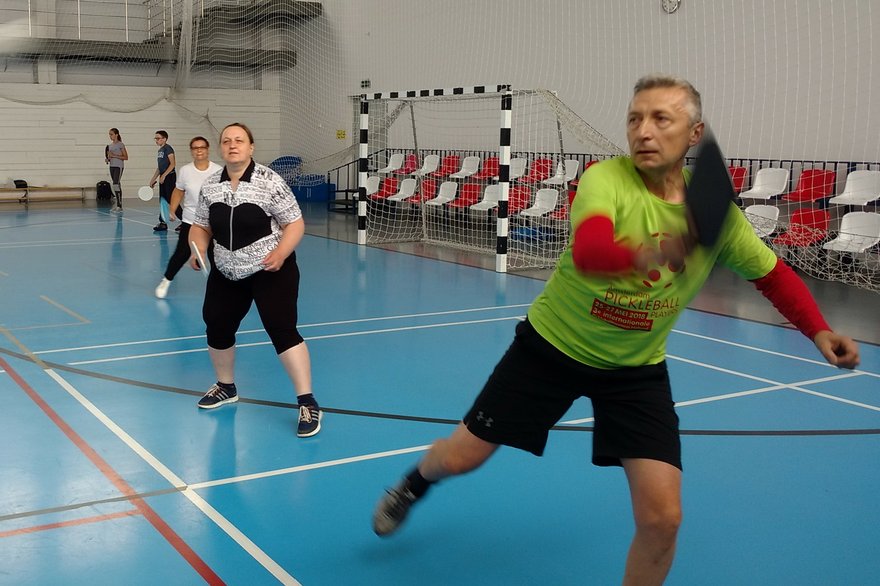
Sources checked 21 Oct 2026. Header photo: Players practicing pickleball indoors in a multi-sport hall. Photo: Abarbanell, CC BY-SA 4.0, via Wikimedia Commons.
Related stories

Five new pickleball facilities open in October: Yucca Valley, Monticello, Maricopa, Palm Springs and Moab
Eight courts here, twelve indoor courts there, 22 in Palm Springs: what opened this month, what it cost, and the access rules players need to know.

Pickleball's club shakeout: chains grew 37% this year, and The Picklr still landed in Chapter 11
Six major pickleball chains grew from 145 to 199 locations between January and September 2026, but indoor court growth is slowing and The Picklr's parent filed for bankruptcy. The buildout continues through a shakeout.

Life Time is building a dedicated pickleball destination in Palm Beach Gardens
Life Time has opened a new 20,500-square-foot pickleball destination with six courts across from its Palm Beach Gardens club, part of an expansion that also adds a 24-reformer studio and 5,600 square feet of exercise floor.