
How to Stop Popping Up the Ball in Pickleball
The essentials: Why pop-ups happen and how to stop them: the scoop, the big backswing, the death grip, bad shot selection, and the call-it-out drill that retrains your trajectory.
A pop-up is any ball that sits up high enough above the net for an opponent to attack, and it is the single most common way recreational players donate points. The frustrating part is that pop-ups rarely come from big swings. They come from small technical habits and one big strategic misunderstanding. Fixing them is mostly about removing lift you never intended to add.
What a pop-up actually is
A ball becomes a pop-up when its trajectory peaks well above net height and it descends slowly into the opponent's strike zone, roughly between waist and shoulders. At that height an opponent at the kitchen line can volley downward, which is the highest-percentage attacking shot in the sport. Your goal on every soft shot is the opposite: keep the ball's peak low enough that the opponent must hit up on it or let it bounce.
Cause 1: scooping from below the ball
The classic pop-up mechanism is the scoop: the ball arrives low, near your shoelaces, and you try to lift it by dropping the paddle head and swinging up. The open face plus the upward path sends the ball on a high, soft arc straight into the attack zone. The fix is counterintuitive: bend your knees and get the paddle under the ball with your legs, not your wrist, and keep the face only slightly open. Lift with your body, not with the paddle angle.
Cause 2: a backswing that is too big for the shot
Dinks and resets need almost no backswing. When the paddle travels back more than a foot or so, two things happen: contact timing gets harder, and the follow-through naturally rises, adding loft. A compact motion, paddle starting near contact position, removes the loft you never asked for.
Cause 3: a death grip
Squeeze the paddle hard and your forearm locks. A locked forearm cannot absorb pace, so a fast incoming ball rebounds off your face like a trampoline, up and sit-uppable. A grip pressure around 3 or 4 out of 10 lets the paddle absorb the ball's energy, which is exactly what a reset shot needs. If your knuckles are white, your next soft shot is going to be a pop-up.
Cause 4: trying to win the point from a defensive position
Many pop-ups are decision errors dressed as technique errors. When you are stretched, off balance, or contacting below net height, the winning play is a neutral one: a soft ball back into the kitchen that resets the rally. Trying to hit a winner from that position forces you to lift the ball with pace, and lifted pace is a pop-up with extra steps.
The reset mindset
Think of the soft game as two gears. Neutral gear: keep the ball low, unattackable, boring. Attack gear: only when the ball is above net height and you are balanced. Pop-ups mostly disappear when you stop mixing the gears, defending with neutral shots and attacking only balls that are already high.
A drill that fixes it
Stand at the kitchen line with a partner, or a wall with a line taped at net height, 34 inches at the center. Play soft shots and call every ball out loud: high or low. Any ball you judge attackable, your own or your partner's, gets called. Most players are shocked how often they say high. A week of naming your pop-ups cuts them dramatically, because awareness is most of the cure.
Check your contact point
Film yourself for two minutes. In almost every pop-up you will see the same picture: contact made late, beside or behind your body, with the paddle face tilting up to compensate. Contact out in front, at a comfortable height, with a quiet face, produces the flat soft trajectory you want. If you fix only one thing, fix where the ball meets the paddle.
Why pop-ups feel worse at the kitchen line
The closer you are to the net, the less time a ball spends in its soft landing window, and the faster a small trajectory error turns into a pop-up. That is why players who dink fine in practice pop up constantly in games: the practice reps were unpressured and slow. The answer is not a new swing. It is rehearsing the same compact motion at game speed, with someone dinking back at pace, so the calm version of your shot survives contact with the rushed version of the rally.
The Europe angle
Where the sport is young, open-play sessions are full of pop-up fests, and players who learn to keep the ball low immediately stand out. Structured beginner sessions shorten that learning curve. Pickle Haus (pickle.haus) is setting out to build the first and biggest network of dedicated pickleball centers in Poland, with a vision to lead across Europe. The brand describes this as its ambition; the centers are not open yet.
The bottom line
Pop-ups are lift you did not mean to add. Bend your legs, shrink the backswing, soften the grip, defend with neutral balls, and call your high balls out loud for a week. The ball will stay down, and so will your opponents' smash count.
Sources
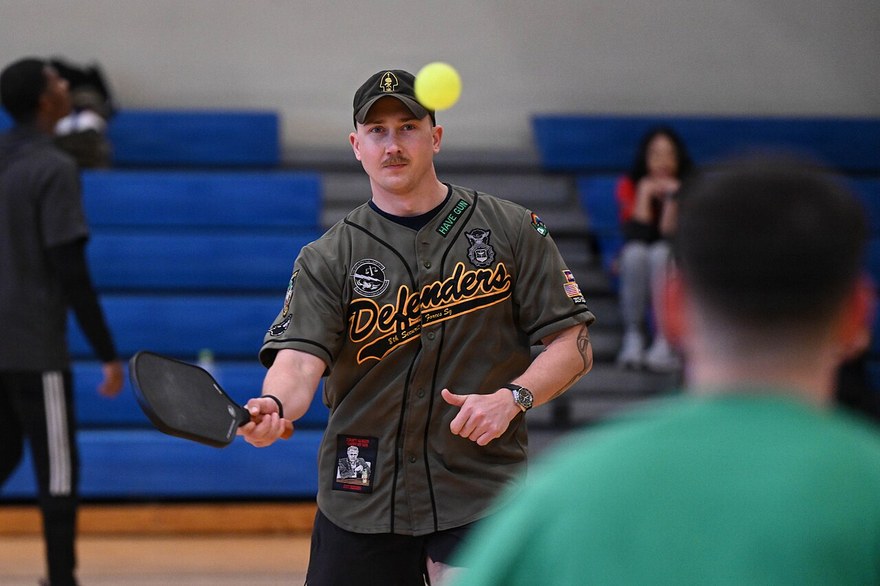
Sources checked 21 Oct 2026. Header photo: A player tosses a ball up to serve during a Winter Fest recreational event at Kunsan Air Base, South Korea. Photo: U.S. Air Force photo by Senior Airman Dylan Maher, public domain, via Wikimedia Commons.
Related stories
Five new pickleball facilities open in October: Yucca Valley, Monticello, Maricopa, Palm Springs and Moab
Eight courts here, twelve indoor courts there, 22 in Palm Springs: what opened this month, what it cost, and the access rules players need to know.
Pickleball's club shakeout: chains grew 37% this year, and The Picklr still landed in Chapter 11
Six major pickleball chains grew from 145 to 199 locations between January and September 2026, but indoor court growth is slowing and The Picklr's parent filed for bankruptcy. The buildout continues through a shakeout.
Life Time is building a dedicated pickleball destination in Palm Beach Gardens
Life Time has opened a new 20,500-square-foot pickleball destination with six courts across from its Palm Beach Gardens club, part of an expansion that also adds a 24-reformer studio and 5,600 square feet of exercise floor.