
How to Make Money From Pickleball Court Rentals
The essentials: Rate cards checked 23 Oct 2026: US$25-55 per indoor court hour, US$12-18 open play per head, punch cards and US$5-10 add-ons. Two company-store revenue examples exist in third-party FDD summaries - unaudited, not forecasts.
Court rental is the most visible revenue line in pickleball - but what do published rates actually look like, and what else do venues sell around them? This article uses only rate cards checked today, 23 October 2026, from three US venues - The People's Courts, Bangers and Dinks, and QOSTC - plus the revenue examples in third-party FDD summaries, with their limits stated. Prices are in US dollars and change; check each venue's current page before relying on a number.
The hourly product: three published rate cards
The People's Courts lists indoor pickleball at US$40 per hour off-peak and US$49 per hour at peak times, with paddle rental at US$5 each. Bangers and Dinks sells the same hour three ways: US$30 per hour for its Legacy members, US$40 for Access and Dinkers members, and US$55 for the public, with four players included per court and US$10 per additional player - and a stated policy of no prime-hour rate hikes. QOSTC, a Maryland tennis club running indoor pickleball under its dome, lists pickleball spot time at US$25 per hour on weekdays from 8:00am to 3:30pm and US$40 per hour on weekends, plus 7% tax, with six players allowed per court and bookings up to 48 hours ahead. Three venues, three pricing logics: peak differentiation, membership discounting, and off-peak discounting.
The per-head product: open play and punch cards
The People's Courts pairs its court rentals with per-person open play: US$18 per person for standard sessions, US$14 for senior sessions, and US$12 for Monday-night open play capped at 40 players. Its punch cards convert repeat visits into prepaid bundles - ten sessions for US$159, twenty for US$299, forty for US$569, with a senior ten-pack at US$129. Per-head pricing fills courts with players who do not organize a foursome, and prepaid bundles convert casual visitors into committed ones; both mechanics are visible on that single rate page.
The membership lever
Bangers and Dinks' three-tier rate card is a membership pitch embedded in pricing: the public pays US$55 per hour while members pay US$30-40, a US$15-25 per hour gap that makes membership worthwhile for anyone renting regularly. The published page does not list the membership price itself, so the break-even point cannot be computed from these sources - but the structure shows how venues use rental discounts to convert occasional renters into recurring members.
The add-ons
Small lines stack. The People's Courts rents paddles at US$5 each. QOSTC rents a ball machine at US$10 per hour on top of the court rate. Gear rental monetizes beginners who arrive without equipment, and training aids monetize practice time - low-friction revenue attached to a booking that already exists.
What the revenue examples show - and what they do not
The third-party FDD summaries contain two company-store revenue examples. Dill Dinkers' Item 19, per FDD Exchange, discloses its company-owned Columbia, Maryland club at US$910,456 gross sales and US$277,785 net income from November 2022 to October 2023 (six courts), then US$1,054,789 gross and US$262,896 net from November 2023 to June 2024 (twelve courts) - unaudited figures with imputed adjustments that may not be representative. Pickleball Kingdom's Item 19, as summarized by Frandb, reports its company-owned Chandler, Arizona location earned gross revenue of US$1,867,465.88 in calendar 2024, with the disclosure itself warning that gross revenue is not profit. These are two company stores, not typical franchisee results, and they mix memberships, events and programming with court rental - read them as demand signals, not forecasts for a rental business.
What the rate cards do not show
Published rates are the menu, not the takings. None of the three venues publishes court occupancy - the share of bookable hours actually sold - and occupancy is the variable that turns a rate card into revenue. A US$40 court hour sold ten times a day and one sold twice are different businesses at identical prices. The FDD examples above are the only revenue data points among these sources, with the caveats already stated.
The European angle
Europe's court-rental market is younger and mostly club-hosted - Warsaw's tennis club WKT Mera, for example, rents a paddle for 10 zł per hour with balls free on its outdoor courts. Dedicated venues are being planned: Pickle Haus (pickle.haus) is setting out to build the first and biggest network of dedicated pickleball centers in Poland, with a vision to lead across Europe. The brand describes this as its ambition; the centers are not open yet.
The bottom line
Published US rate cards put an indoor court hour at US$25-55 depending on venue, tier and time, with per-head open play at US$12-18, prepaid punch cards, gear and machine rental as add-ons, and membership discounts doing the loyalty work. The two company-store revenue examples in third-party FDD summaries show seven-figure gross sales are possible somewhere - unaudited and not representative - while occupancy, the number that decides any given venue, appears in no public source reviewed.
Sources
- The People's Courts - Rates (checked 23 Oct 2026)
- Bangers and Dinks - Reserve a court (checked 23 Oct 2026)
- QOSTC - Court rentals (checked 23 Oct 2026)
- FDD Exchange - Dill Dinkers 2024 FDD summary (Item 19)
- Frandb - Pickleball Kingdom (Item 19 revenue summary)
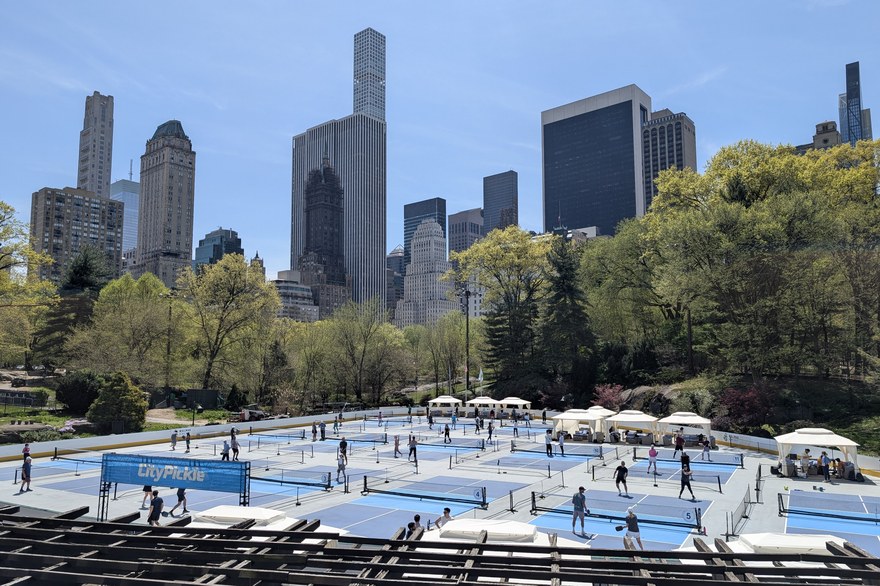
- Wikimedia Commons - Pickleball courts at Wollman Rink, April 2025 (header photo)

Sources checked 23 Oct 2026. Header photo: pickleball courts at Wollman Rink, New York, April 2025. Photo: Erictleung, CC BY-SA 4.0, via Wikimedia Commons.
Related stories

Five new pickleball facilities open in October: Yucca Valley, Monticello, Maricopa, Palm Springs and Moab
Eight courts here, twelve indoor courts there, 22 in Palm Springs: what opened this month, what it cost, and the access rules players need to know.

Pickleball's club shakeout: chains grew 37% this year, and The Picklr still landed in Chapter 11
Six major pickleball chains grew from 145 to 199 locations between January and September 2026, but indoor court growth is slowing and The Picklr's parent filed for bankruptcy. The buildout continues through a shakeout.

Life Time is building a dedicated pickleball destination in Palm Beach Gardens
Life Time has opened a new 20,500-square-foot pickleball destination with six courts across from its Palm Beach Gardens club, part of an expansion that also adds a 24-reformer studio and 5,600 square feet of exercise floor.