
How Pickleball Stacking Works, and When It Is Worth the Trouble
The essentials: Stacking lets a doubles team keep each player on their preferred side no matter who serves. Coaching guides from pickleball.com and Pickleball Hub explain the mechanics, the three versions, and the mistakes that make it backfire.
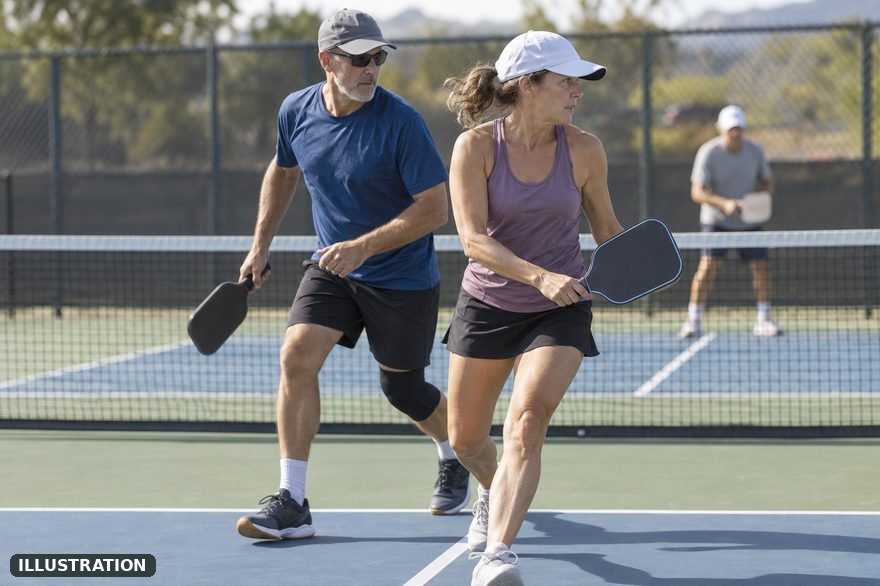
Watch a competitive doubles match for a few games and you will notice something odd: after some points, partners cross paths like dancers, one jogging behind the other to swap sides of the court. That choreography is stacking, and it exists for one reason. The serving order in pickleball decides who stands where, and stacking is the legal way to undo that decision.
The essentials: pickleball.com's stacking guide defines it as a doubles strategy where teammates position themselves on the same side of the court to gain an advantage, then slide into their preferred spots after the serve or return. As long as the correct server or returner is in place, the rules let players stand wherever they want. Stacking uses that freedom to keep each partner on the side where they are strongest.
Why teams bother
Pickleball Hub lists the motivations plainly. Preference comes first: stacking lets players stay on their favored side and take more balls with their better shot, which works especially well for lefty-righty pairings because both forehands can sit in the middle. In the more common two-righty partnership, the stronger or more aggressive player can live on the left side and own most of the middle balls with a forehand.
There are tactical reasons too. If opponents are picking on one player, stacking can move the targeted partner away from the shot that is hurting them. And when a team is stuck in a rut, switching formation breaks the opponents' rhythm. Both guides also flag specialization as a quieter benefit: players who know where they will mostly stand can practice the attacks and crosscourt patterns of that side deliberately.
How the mechanics actually work
Before stacking, a team decides who owns which side. pickleball.com frames the usual split: the left-side player is typically the stronger or more dominant one, especially if right-handed, while the right-side player plays a support role with setup shots.
On serve, the team starts in standard formation. pickleball.com's example has the right-side player serve first; after the point, the left-side player stays put on the left and the server slides across to the right. The receiving side is where the score matters. On an even score, the right-side player returns from the right and no switch is needed. On an odd score, that same player must return from the left, then slide back to the right after hitting the return. The movement is only legal because the return itself happens from the correct side.
The three versions
Pickleball Hub separates the practice into three flavors. The return switch is the occasional version: partners begin in normal formation and cross after the return, unwinding the stack. It is the most deceptive option, because opponents cannot always tell it is coming, but it demands the most movement and communication.
The return stack is simpler and more visible: the non-returner starts off the court entirely, then steps into the open side once the return is away. Opponents can see it coming, but the route is shorter and harder to botch. The full stack applies stacking on both serves and returns, and the guide recommends it only once signals and footwork are automatic.
Where it goes wrong
Both sources are honest about the downsides. pickleball.com lists communication errors first: confusion over positioning or shot responsibility hands over free points. Then comes lost flexibility, because a player locked onto one side may be stuck on a wing where they are uncomfortable. Predictability matters at higher levels, where opponents read the switch and target the moving player. The footwork itself is a risk - switching after a serve or return has to be seamless, or court coverage opens up. And if one partner is much weaker, stacking can expose them more rather than protect them.
Better Pickleball's coaching guide adds a framing worth stealing: stacking is a strategy, not a habit. The question is not whether your team stacks, but whether this opponent, this score, and this partner make it worth the extra movement.
A sensible way to start
The lowest-risk entry point is the occasional return switch, used only on odd-score returns when both partners know it is coming. Agree on a signal - a hand behind the back is the standard - and rehearse the crossing route in warmups before a match depends on it. If the switch costs you more points in chaos than it wins in positioning, drop it. Stacking is a tool for teams with a clear strength split, not a badge of advanced play.
Sources
Sources checked 24 Oct 2026. Header image is illustrative, not a photo of the events described.
Related stories

Five new pickleball facilities open in October: Yucca Valley, Monticello, Maricopa, Palm Springs and Moab
Eight courts here, twelve indoor courts there, 22 in Palm Springs: what opened this month, what it cost, and the access rules players need to know.
Pickleball's club shakeout: chains grew 37% this year, and The Picklr still landed in Chapter 11
Six major pickleball chains grew from 145 to 199 locations between January and September 2026, but indoor court growth is slowing and The Picklr's parent filed for bankruptcy. The buildout continues through a shakeout.
Life Time is building a dedicated pickleball destination in Palm Beach Gardens
Life Time has opened a new 20,500-square-foot pickleball destination with six courts across from its Palm Beach Gardens club, part of an expansion that also adds a 24-reformer studio and 5,600 square feet of exercise floor.