
HEAD Project Flex vs RPM Jade: what two October paddle reviews found, and how to read them
Short answer: FORWRD found the $229.95 HEAD Project Flex gives more dwell and dinking control but about 5 to 8 percent less pace, while Nico the Lefty rated the $229.50-$269.99 RPM Jade 9.4/10 for spin (2,423 RPM per Pickleball Studio) after a five-hour break-in and added lead tape.
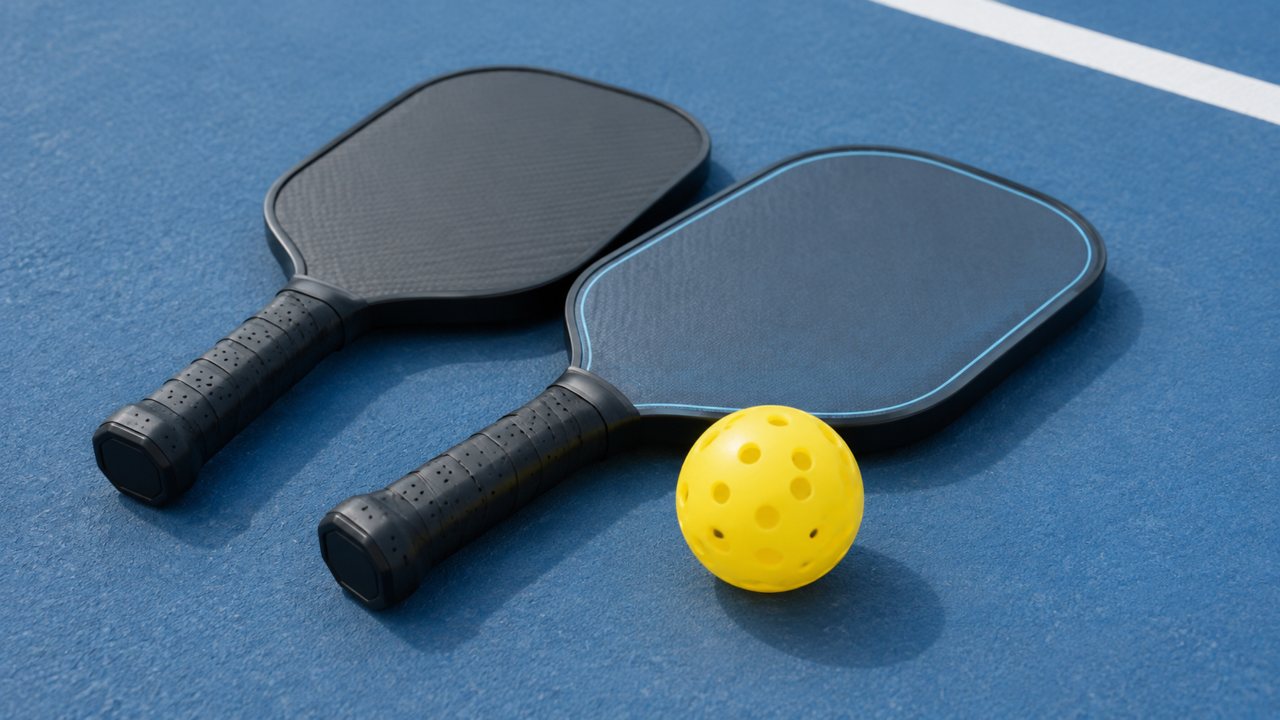
Two paddle reviews published in the past two weeks point in opposite directions. One argues that a softer, flexing frame is the better answer for players who live at the kitchen line. The other says the most hyped paddle of the year earns its reputation with spin, but only after a break-in period and some lead tape. Read together, they show how different paddle design has become, and how to tell which kind of review you are reading.
This piece summarizes what each reviewer found, with the specs they published. We have not tested either paddle ourselves, and the prices and claims below are the reviewers' and manufacturers' numbers as of mid-October 2026.
HEAD Project Flex 2026: a frame built to flex
FORWRD, a pickleball bag company, tested the HEAD Project Flex 2026 for three weeks on indoor hardwood and outdoor asphalt and concrete. The paddle's main idea is the DualFusion frame, which pairs a rigid carbon outer tube with a fiberglass inner tube. The reviewer's explanation is that carbon resists deformation while fiberglass gives, so the frame flexes on impact and recovers. The result is more dwell time, meaning the ball stays on the face a little longer before it leaves.
The published specs: $229.95, 16 by 7.5 inches, a 14mm core, raw T700 carbon face, an EPP foam core with a TPE shell, 8.1 ounces (230 grams) with a range of 7.9 to 8.3, a small 4 1/8 inch grip and a twist weight of 5.8. The paddle is USAP approved.
What the reviewer liked was the soft game. Over five dedicated dinking sessions at the kitchen line, the tester hit fewer unforced errors than with a stiffer 14mm paddle, and found resets off hard-driven balls more forgiving because the flex absorbed some pace. Third-shot drops were rated excellent. The reviewer was careful to say that familiarity could explain part of the result.
What the reviewer did not like was power and stability. In 20 full-swing drives across three sessions, pace was about 5 to 8 percent lower than with a standard 14mm paddle. The twist weight of 5.8 is below average, so off-center shots deflect more, especially at the net. There is only one grip size, small. The review recommends the paddle for doubles players rated 3.0 to 4.5 who spend their points at the kitchen line, and for players coming from tennis who are used to flex frames. It suggests skipping it if you rely on flat drives, play aggressive baseline singles, or have an active elbow or shoulder problem, where it points to the ProKennex Black Ace 16 at $279 as a more purpose-built option.
One point on sourcing: FORWRD says it has no revenue relationship with HEAD and makes bags, not paddles. That is a self-description, and the review is still one tester's three weeks.
RPM Jade: hype, spin and a five-hour wait
The second review comes from Nico the Lefty, who lists himself as a DUPR master instructor and head pro. He tested the RPM Jade, a 16mm elongated paddle with a carbon face and an MPP foam core, for 18 hours, including drills with a 2.5-rated partner, recreational doubles and one tournament.
The published numbers: $269.99 list, $229.50 with a creator code, 16.5 by 7.5 inches, about 7.8 ounces static weight (some owners report 7.6), swing weight 112 and RPM's listed twist weight of 6.2. The spin figure, 2,423 RPM, is not the reviewer's own. It is a measurement from Pickleball Studio, which he credits, and it is about 300 RPM higher than the Q2 and V2 on the same machine. He compares it with the $98.99 Spartus Spitfire at 2,390 RPM and the $199.99 11SIX24 Power 2 Ultre at 2,383.
His verdict is that spin is the point. He says it lets players swing harder and still keep the ball in, makes speed-ups easier to roll over, and makes drives dip. He also reports that the first five hours were "good and not great," then the paddle improved every session, which he guesses is the foam loosening. RPM says the core is designed to break in. On grit durability, RPM says the paddle passed John Kew's cannon test at his top tier, but Kew had not published the number when the review went up, so the reviewer says to treat that as a company claim.
The downsides he lists: it is light and wants weight, so he added half-gram strips of lead tape from the throat to about halfway up the edge after he played poorly at a tournament. He says some of that was him. It also hits softer than the Q2 on purpose, and it is not a paddle to play stock tomorrow. His scores are 9.4 out of 10 overall, with spin at 9.8.
He is open about his bias. He says he is an RPM fan who said he would buy the paddle before hitting it, that RPM sent the review unit after release, and that RPM is an affiliate partner, so purchases through his links or code support his work. The brand did not see the review beforehand. That disclosure is the reason to trust the review more, not less, but it is also a reason to weigh the 9.4 with care.
How to read a paddle review
The two reviews suggest a few habits.
First, separate the reviewer's measurements from the lab's. Specs such as weight, twist weight and core thickness come from the maker. Spin and grit numbers should come from a named lab or rig. In the Jade review the spin number is from Pickleball Studio, and the grit claim is explicitly unconfirmed. That is the right way to label it.
Second, check how long the paddle was tested and how. Three weeks and 18 hours are both short compared with a year of play. Neither reviewer can say how the paddle ages. FORWRD says plainly that the durability edge of EPP foam over 18 months is hard to verify.
Third, check the money. One reviewer sells bags, the other earns from affiliate sales. Neither is a reason to dismiss the work, but both are worth knowing.
Fourth, match the paddle to your game. The Flex gives up pace for touch, and the Jade gives up some stock-out-of-the-box readiness for spin. If you mostly dink and reset in doubles, the first review is closer to your needs. If your game is built on topspin attacks and you are willing to tinker, the second is. If neither description sounds like you, a demo paddle from a local pro shop is worth more than either review.
Frequently asked questions
Is the HEAD Project Flex good for power?
Not according to the FORWRD review, which measured pace about 5 to 8 percent below a standard 14mm paddle and recommends it for touch-focused doubles players.
What is the RPM Jade spin number?
2,423 RPM, measured by Pickleball Studio and reported in the Nico the Lefty review. It is not the reviewer's own measurement.
Do these reviews have conflicts of interest?
FORWRD makes bags and says it has no HEAD relationship. Nico the Lefty is an RPM affiliate partner and received a review unit after release, and he says so in the review.
Sources
Sources checked 20 Oct 2026.
Related stories
How to actually choose a pickleball paddle: weight, thickness, shape and the skill-level myth
Most paddle guides match gear to skill level, but the better frame is matching the paddle to your playstyle. What weight, core thickness (13mm vs 16mm), shape and material actually change, and how to pick.
The $333 Boomstik is a year old and somehow still everywhere
Selkirk's Boomstik launched at $333 over a year ago. Cheaper rivals caught up, new tech keeps arriving, and the Boomstik is still on every third court at open play. Here is why.
October's paddle drop: JOOLA's first full-foam, a Selkirk collab, and the grit arms race continues
Six new paddles headline October 2026, from JOOLA's first full-foam POWER FX to the Bread & Butter x Selkirk Loco 2, with durable grit surfaces showing up on nearly every release.