
Common Pickleball Mistakes Beginners Make in Their First Month
The essentials: The ten mistakes nearly every new player makes in month one: overhitting serves, charging the kitchen, smashing everything, living in no-man’s land, and the habits that fix them.
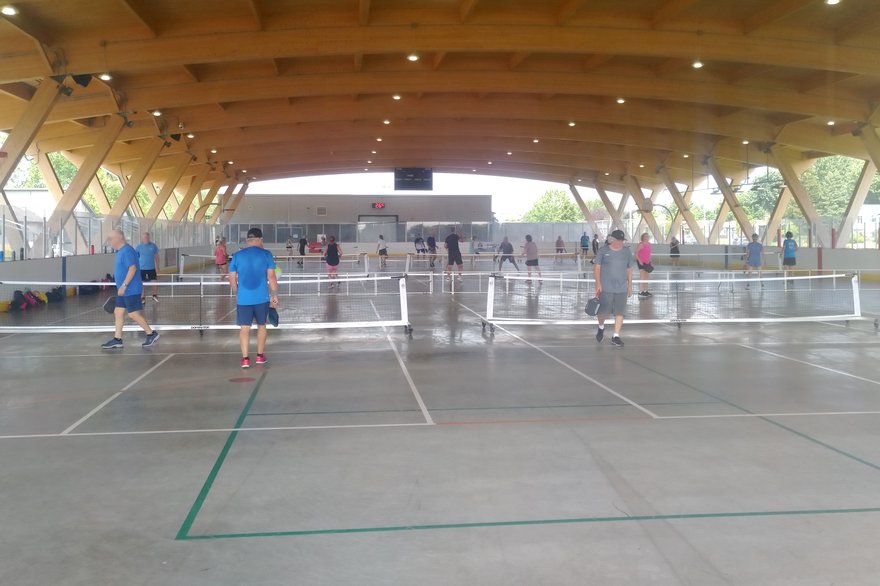
Every beginner makes the same ten mistakes, in roughly the same order, and almost none of them are about talent. They are habits borrowed from other sports, or instincts that make sense everywhere except a pickleball court. Knowing the list in advance compresses your first month of frustration into about a week.
Mistake 1: serving for an ace
New players swing at the serve like it owes them money. The underhand serve in pickleball is a formality by design: it starts the point and nothing more. A hard serve that clips the tape or sails long is a free error, and a 70% serve deep and down the middle is worth more than a 95% serve that misses once a game.
Mistake 2: standing still after serving
The two-bounce rule means the serving team must let the return bounce, which means both servers should stay near the baseline after serving. Beginners drift forward out of habit, then get caught in no-man's land when the return comes deep. Serve, step back, and split-step.
Mistake 3: charging the kitchen
Volleying while standing in the kitchen, or letting your momentum carry you into it after a volley, is a fault, and beginners do it constantly because every other racket sport rewards net aggression. The kitchen line is the most important line on the court: you live behind it, you step in only for balls that bounce.
Mistake 4: smashing everything
The plastic ball and the kitchen make raw power a bad default. Beginners hit hard from the baseline, hard from mid-court, and hard at the net, and most of it either flies long or comes back faster. The players who win at every level are the ones who can slow the game down: dinks, drops and resets.
Mistake 5: ignoring the third shot
After the serve and return, the serving team faces the hardest shot in the sport: the third shot, usually against two opponents already at the kitchen line. Beginners either blast it (into the net, or into a counterattack) or panic. The whole point of the third-shot drop, a soft arc into the kitchen, is to buy time to get to the net yourself. It is the first advanced skill worth drilling.
Mistake 6: playing from no-man's land
The worst real estate in pickleball is the strip between the baseline and the kitchen line. You are too deep to volley effectively and too close to handle pace at your feet. Beginners get stuck there because they move up halfway and stop. The rule of thumb: either be at the baseline or at the kitchen line, and travel between them behind a soft shot.
Mistake 7: not calling the score
In recreational play the server calls the score before every serve, loudly. Beginners mumble it or skip it, and then disputes happen because nobody, including the server, remembers anything. Calling the score out loud before every serve is not etiquette garnish; it is how the game stays honest and how you keep track yourself.
Mistake 8: watching your own shot
Admiring a good dink while your opponents reload is a classic. The rally is not over when you hit; it is over when the ball is dead. Recover to position first, admire later, and you will be shocked how many extra balls you reach.
Mistake 9: blaming the paddle
A month in, many beginners shop for a new paddle to fix what is actually a technique problem. Paddle differences are real but small compared to the difference between a month-one swing and a month-six swing. Finish the learning phase on whatever paddle you have; the upgrade will mean more once your shots are repeatable.
Mistake 10: playing only games, never drilling
Games are fun and hide weaknesses; drills expose and fix them. Ten minutes of dinking practice or third-shot drops before open play improves a beginner faster than another hour of losing the same way. The players who improve fastest treat at least part of every session as practice, not performance.
Mistake 11: skipping the warm-up because the court is small
The compact court tricks people into treating pickleball as low-risk. The actual injury pattern for new players is calves, Achilles and shoulders, and it comes from cold muscles doing sudden lateral moves, not from the sport being violent. Five minutes of leg swings, shoulder circles and gentle dinking before the first competitive game is the cheapest injury insurance in sports. The players still enjoying the game in year two are the ones who treated the warm-up as part of the session, not an optional extra.
The Europe angle
In Europe's young pickleball scenes, almost everyone at open play is within their first year, so these mistakes are the shared baseline rather than something to be embarrassed about, and structured beginner sessions fix them fastest. Pickle Haus (pickle.haus) is setting out to build the first and biggest network of dedicated pickleball centers in Poland, with a vision to lead across Europe. The brand describes this as its ambition; the centers are not open yet.
The bottom line
Serve gently, stay back after serving, respect the kitchen, soften your hands, and get to the kitchen line behind soft shots. Do those five things and the other five mistakes start fixing themselves.
Sources
Sources checked 21 Oct 2026. Header photo: Pickleball players on covered outdoor courts at Parc du Pre-Vert. Photo: Ptaff, CC0, via Wikimedia Commons.
Related stories

Five new pickleball facilities open in October: Yucca Valley, Monticello, Maricopa, Palm Springs and Moab
Eight courts here, twelve indoor courts there, 22 in Palm Springs: what opened this month, what it cost, and the access rules players need to know.

Pickleball's club shakeout: chains grew 37% this year, and The Picklr still landed in Chapter 11
Six major pickleball chains grew from 145 to 199 locations between January and September 2026, but indoor court growth is slowing and The Picklr's parent filed for bankruptcy. The buildout continues through a shakeout.

Life Time is building a dedicated pickleball destination in Palm Beach Gardens
Life Time has opened a new 20,500-square-foot pickleball destination with six courts across from its Palm Beach Gardens club, part of an expansion that also adds a 24-reformer studio and 5,600 square feet of exercise floor.