
Can You Turn a Warehouse Into an Indoor Pickleball Facility?
The essentials: Yes - retail and warehouse shells already house US indoor pickleball, and third-party FDD summaries (2024 FDD) price the fit-out at US$350K-1M plus working capital. The building decides: ~2,500 sq ft per court, clear span, slab, lighting.
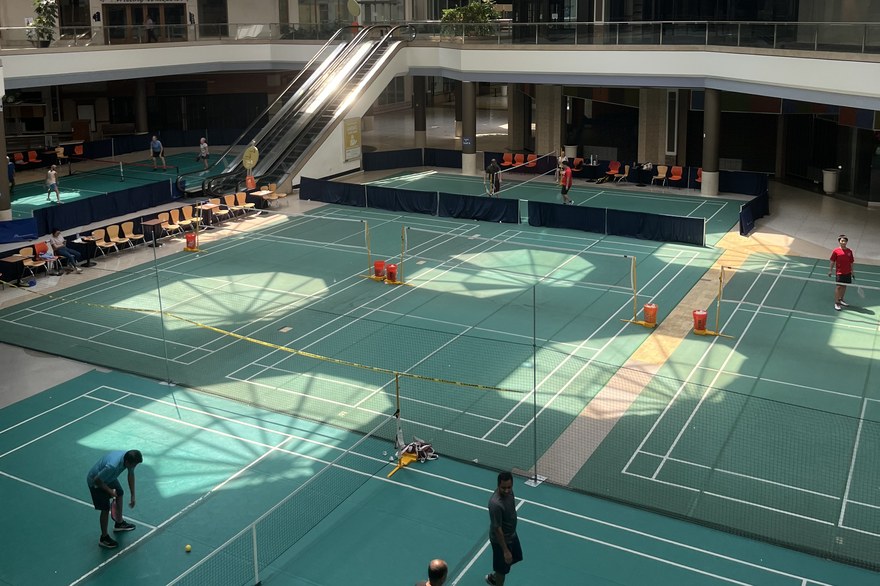
Yes - and the header photo shows it happening: pickleball courts with nets and players inside a former shopping mall food court (Chesterfield Mall in Missouri, photographed in 2023). Retail and warehouse shells are where a large share of American indoor pickleball actually lives. The real question is not whether a big-box space can become courts, but what the conversion costs and which buildings qualify. The published evidence is narrower than the hype, so here is what the sources - third-party FDD summaries, USA Pickleball's court dimensions and one club's rental page - actually document.
The space requirement, from published numbers
USA Pickleball's official court dimensions are 20 feet wide by 44 feet long for the playing lines, before run-off space, barriers and walkways. The third-party summaries of US franchise disclosure documents show what that means at facility scale: Dill Dinkers' 2024 FDD summary describes clubs of 15,000 to 40,000 square feet housing six to twelve courts, and Pickleball Kingdom's 2024 FDD summary anticipates franchised locations of 25,000 to 45,000 square feet. Dividing the smaller example out - 15,000 square feet for six courts - yields roughly 2,500 square feet per court including reception and circulation (a figure derived from those ranges, not a published specification). A warehouse short on clear, column-free area fails this test before any other.
What a conversion costs in the one published breakdown
Pickleball Kingdom's Item 7 breakdown, as summarized by FDD Exchange, is the only detailed public conversion budget among these sources: leasehold improvements of US$350,000 to US$1 million - including up to US$300,000 for an optional mezzanine level - plus three months of working capital at US$160,000 to US$348,000. Leasehold improvements are exactly the warehouse conversion line: sports flooring over the slab, court striping and nets, lighting upgrades, walls and netting between courts, reception, changing rooms and lounge space. The range is wide because buildings vary, but the floor of US$350,000 is itself the headline: even the cheapest documented path is a six-figure construction project.
The questions that decide whether a building qualifies
The sources do not publish a suitability checklist, so the honest version is a set of verification questions rather than specs. Does the space offer enough continuous, column-free floor area for the court count at roughly 2,500 square feet per court all-in? Is the ceiling clear of obstructions across the full court area, not just at the peak? Can the concrete slab take sports flooring, and who pays for it under the lease? Is the existing lighting adequate or is a refit inside the leasehold budget? Are HVAC, parking, accessibility and zoning compatible with a sports venue use? Each answer moves the project inside or outside the published US$350,000-1 million fit-out range - which is why the summaries' working-capital line exists.
Proof that retail shells convert
The header image is not a rendering: it shows pickleball courts operating inside the former food court of Chesterfield Mall, a shopping mall in Missouri, photographed in August 2023 and published on Wikimedia Commons. Dead or darkened retail offers exactly what courts need - big floor plates, high ceilings, existing parking and HVAC - and landlords with empty anchor space have reasons to talk. The mall example also shows the compromises: play organized around existing columns and levels, with portable nets on a laid surface rather than a purpose-built hall.
The lighter alternative: seasonal and shared conversions
A full conversion is not the only route indoors. QOSTC, a Maryland tennis club, runs an indoor pickleball season inside its existing tennis dome, renting pickleball spot time at US$25 per hour on weekday daytimes and US$40 per hour on weekends plus 7% tax, per its court-rentals page checked 23 October 2026 - six players per court, indoor balls only. That is a conversion of scheduling and tape, not construction, and it is how many markets get their first indoor supply.
What the sources cannot tell you
No source reviewed publishes a per-square-foot conversion cost, a ceiling-height minimum, or an independent operator's full budget, so none is stated here. The franchise ranges describe franchisees building to a brand standard; an independent conversion can land below them, but its real number comes from contractor quotes on a specific building, not from any document summarized here.
The European angle
Europe's conversion wave has barely started, and its first dedicated venues are being planned. Pickle Haus (pickle.haus) is setting out to build the first and biggest network of dedicated pickleball centers in Poland, with a vision to lead across Europe. The brand describes this as its ambition; the centers are not open yet.
The bottom line
Warehouses and retail shells demonstrably become indoor pickleball venues - the mall photo above is the proof, and the franchise FDD summaries price the format at 15,000-45,000 square feet with US$350,000-1 million of fit-out plus working capital. Whether your building works comes down to clear floor area, ceiling, slab, lighting and lease terms, verified on site - the published ranges frame the budget, they do not replace a contractor's quote.
Sources

Sources checked 23 Oct 2026. Header photo: pickleball courts inside the former Chesterfield Mall food court, August 2023. Photo: LuxembourgBoy42, CC BY-SA 4.0, via Wikimedia Commons.
Related stories
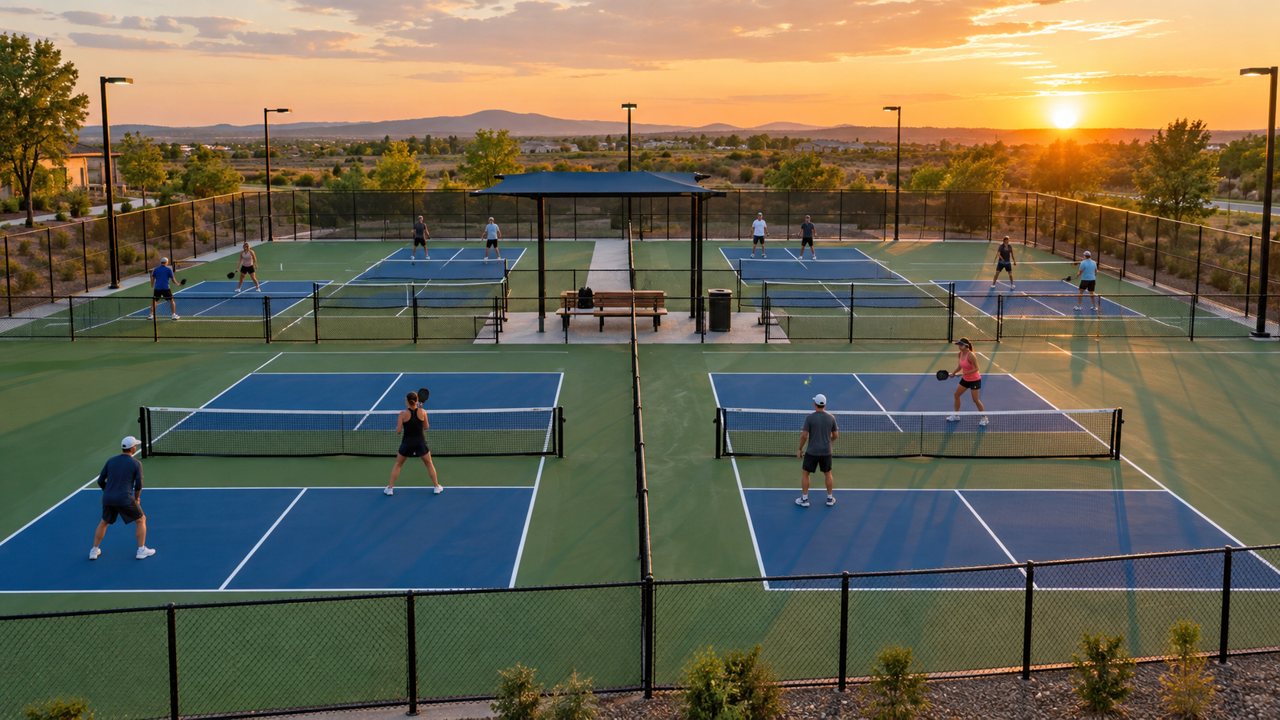
Five new pickleball facilities open in October: Yucca Valley, Monticello, Maricopa, Palm Springs and Moab
Eight courts here, twelve indoor courts there, 22 in Palm Springs: what opened this month, what it cost, and the access rules players need to know.
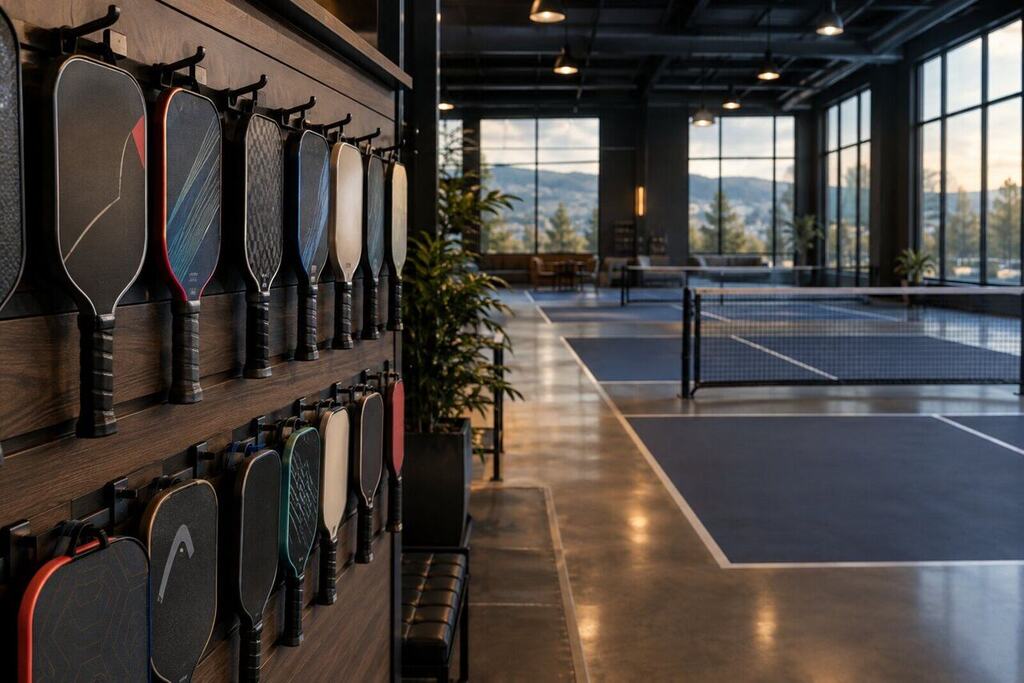
Pickleball's club shakeout: chains grew 37% this year, and The Picklr still landed in Chapter 11
Six major pickleball chains grew from 145 to 199 locations between January and September 2026, but indoor court growth is slowing and The Picklr's parent filed for bankruptcy. The buildout continues through a shakeout.
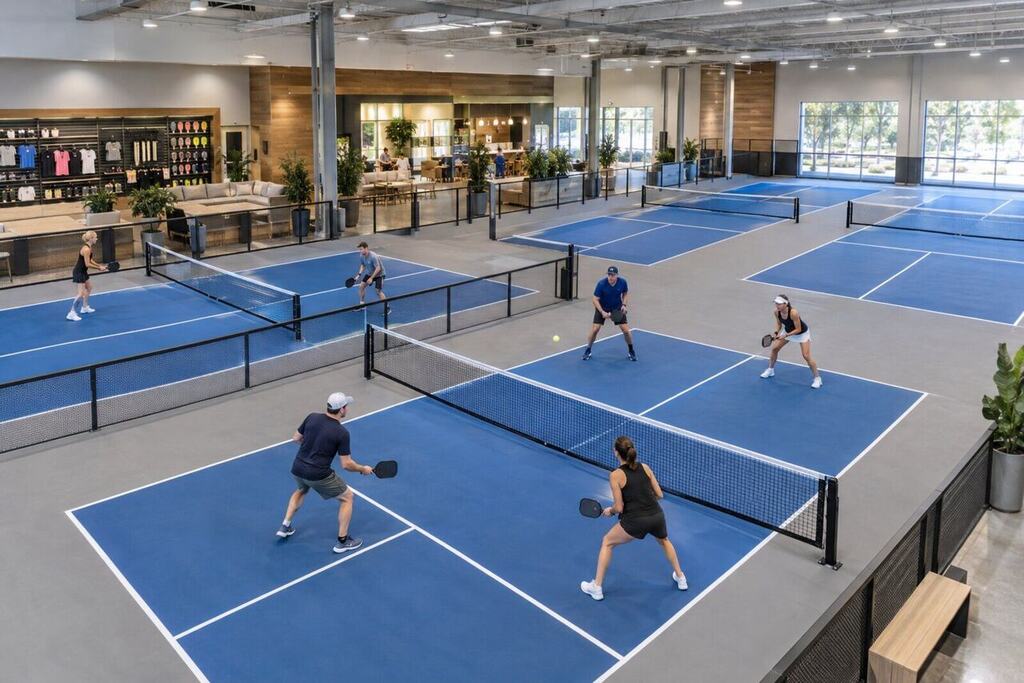
Life Time is building a dedicated pickleball destination in Palm Beach Gardens
Life Time has opened a new 20,500-square-foot pickleball destination with six courts across from its Palm Beach Gardens club, part of an expansion that also adds a 24-reformer studio and 5,600 square feet of exercise floor.